Astrid Bin
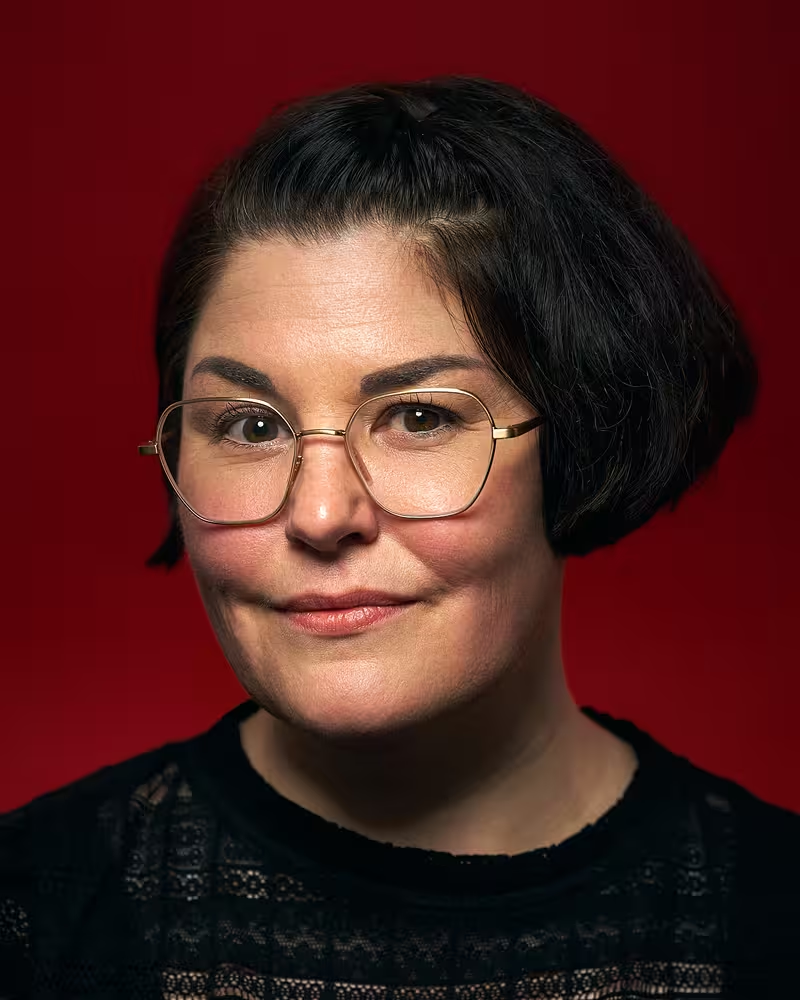
Astrid Bin is a designer and researcher who specialises in making complex things useful, beautiful and understandable. She's spent the last decade working as a music technology designer and researcher, including roles such as the founding designer at Bela and speculative research at Ableton. She is currently a part-time researcher examining e-textile interaction for music, and continues to work as a freelance design consultant for all things interface, interaction, and documentation. She lives in Berlin, and works worldwide.
Talk: Dork Patterns: The Story of Little Character
This is the story of the time I went on a wild goose chase, trying to capture a font that kept eluding me. This mysterious font seemed to have no origin, no author, no history, and maybe wasn’t even really a font at all.
In this talk I tell the story of how this font took a circuitous route through the early days of Silicon Valley, passed by the inventor of the camera phone, through a compiler, and hid for over three decades inside legacy software before becoming my months-long obsession. This is how I (and others) tracked down its origins, how it proves that everything a designer does counts, and that we’re all much more interconnected than we think.
Transcription
(Music)
(Applause)
Thank you so much, Marc.
Thank you to everybody for staying for the last talk.
Thank you, Marc, for trusting me with all of this.(...)
And I have developed this talk in the last five days.
And I thought to myself at lunch, you know what this talk needs? It needs a rewrite.
So it’s even fresher than it was when I got here.
Because, I don’t know, you know how it is. You guys probably give talks, right? You know, you’re just like, “He did a little rat-a-tat-tat.” So we’ll see how this goes. I’ve not given this talk before. This is actually a story that happened this year. So I also changed the name of the talk. This does not match the website. It’s now called “Dork Patterns, the Story of Little Character.”
And my name is Astrid. And before I start, I just want to say thank you so much to all of the other speakers. It is your fault that I rewrote this talk.
(Laughter)
And again, thank you to beyond tellerrand for having me. It’s a very amazing coincidence. I’ve never been to this conference before because I work mainly in the audio industry.(...) And there’s a big audio industry conference, and it’s usually this week. But this year, it’s next week. So the stars aligned. How amazing. And the great thing about giving a new talk last is that if you don’t like it, you can’t have a refund.(...) So Marc’s covered. I’m covered. We’re all covered. And it’s a really kind of weird spot to be in because I wasn’t meant to be here, which also is fitting because I’m going to talk about something that was also not meant to be here.(...) But this is a story about a font.
And before do we have any type designers in the audience?
Yes?
Well, don’t come for me because I know it’s not really a font. It’s a typeface.
I see you.
But this isn’t really about a typeface. This is where the other speakers have informed this talk because I realized I’ve been looking through the through line for this narrative, like the last few days, going, you know, what’s the the zoop that kind of brings it all together?(...) And I thought and then in watching everybody else, I realized what that is. This is a story about dorks.
So thank you, dorks.
And I’m sure that everybody here(...) I mean, you know, if you’re in design and technology, you’re dorky. I’m sorry if you think you’re cool.
I’m here to break it to you. We’re not.
But I’m going to tell you a story in four parts. The first part is how I became obsessed with a font, typeface font.(...) I say the word I use the term font because everybody understands fonts, but people who aren’t designers find typeface. What is that? So I call it a font. Okay, fight me after.(...) I’m also going to tell you the adventure of finding this font’s origins.
I’m then going to tell you what I found out and what happened afterwards. So it’s four parts, but no, you know what? It’s my talk, so there’s a part zero. I’m going to tell you about dorks.
And this is the part that I added today, because I think it’s important to like really meditate on what I mean by dork.
Dorks notice things. And I want you to think about because I know you all have dorkiness within you. I know it.
Decide with me. And so we all notice things. That’s one of the great things. Dorks care about the details. Dorks see things and go, “Ooh, what’s that?” And dorks see the connection between all things, all people, all practices. That’s what makes us excited about stuff.(...) And dorks want to know. They really want to know. And they’re driven by wanting the story.(...) And dorks just won’t let it go.(...) It doesn’t matter how long it’s been. It doesn’t matter how long they’ve been into something. Dorks want they just won’t they can’t get enough. Is anyone familiar with the world of Star Trek fan content?
How many movies? How many different series of Star Trek? On average, seven seasons each. Twenty-two to twenty-five episodes per season. And still the fans say, “I want more.”
So dorks just won’t let it go. They can’t get enough. And dorks imagine a better world. This is one thing I love about dorkiness. Is that you just see the things that you love and you go, “What if everything was like that?” And you can’t have a better world if you can’t imagine it. So being able to imagine things is very important.
And to be a dork, and I think this is the important part, is to have an enormous capacity for love.(...) For example, here are the things that I’m dorky about.(...) This is not inclusive.
AT’s TV, number stations, British biscuits, commercial air travel, the card game, Ramoli, pinball, signal processing, Soviet space program, design history, musical instruments, Star Trek, the glassware of Star Trek.(...) Ask me later. Subway says, “Since municipal watch supplies, futures that never arrived late, Raymond Lowy,” wish I was doing that talk, “Richelle Sull’s knob design, 3D printing, weird stuff, speaker cabinets, car horns, heavy metal, 70 synth grind, psych drone.” But I’m open.
Distortion pedals, World War I military fashion, Dungeons & Dragons, Belfast architecture, I did hold masters on that. Plastics, diagrams, or jewel cuts, urban pavement patterns. Do you ever look under your feet? Trust me.
Parasites, whoa, that’s a... Whoa, neon lights, cool rocks of all kinds. Heavy metal battle jackets, the history of hand washing, fascinating. The Office US version, don’t really like the UK version. Jeopardy question writing, paper processing, you ever know, look how paper’s made? Whoo,
historical jewel high, so... Assembly language, street food, tuning force, percussion sound engineering, pneumatic tube systems, pneumatic tube systems. And you know what, we all have these lists. You have this list, I have this list, we all have these lists. So to be a dork is to have this enormous capacity for love. We can love so many things, so hard, so much, that we become obsessed with them. Which brings me to the first part of this story, which is obsession.
And let me talk about...
I put some anima... I was trying to do some crazy things with animation.
I’m a designer.
I mean...(...) Am I a designer?
We all ask ourselves. I’ve been working mainly in music technology for a very long time. I’ve been a designer for...
If I really sit down and think about it, it’s in excess of 20 years.
And audio is a weird industry, I’m mostly a designer for music technology, but I’ve worked in a lot of areas. But that’s not... I mean, I could tell you about that, but the most important thing to know is that I’m a professional dork.
And I could tell you all these things about design stuff that I’ve worked on, design systems, logos I’ve made, and da-da-da. It’s not that interesting, so let me tell you about the dorky things I do.
I don’t have the usual career path. My bachelor’s was in sculpture.(...) I was too dorky. My master’s was also in fine art. And then I ended up in this PhD program where they took some artists and put them in an engineering school and said, “Boom! See what you can do.”(...) And so I ended up studying musical instrument design. I make digital musical instruments because that was this really good intersection of culture and materials and object making and software and hardware. So it was like, “Yeah, Astrid, here’s the spot for you.” So that’s where I’m kind of coming from. But these days, I’m working as a research fellow at a university in Berlin in the wearable computing department. I make the hardware and do the implementation and some design of wearable touch interfaces for audio control. Here is a sensor that I embroidered.
Can’t do that. You’re not a dork. This is a project that I worked on in Kenya earlier this year. And I don’t think any heavy metal fans in the room. But one of the-- yes! One of the people-- the guys from a very, very-- a band that I absolutely love end up collaborating with him. He’s from Kenya.(...) And him and another artist had looked at the tuning system for this-- this Ugandan xylophone called nimbare. And it’s a really cool xylophone. They’re huge, like massive, like ten people can play them. And they dig a big hole in the ground. They set the xylophone over the top of it. And that big hole acts as the resonator. And these xylophones have very, very specific tuning. And so this artist and this other guy had done some really deep research into what the tuning system was. They wrote a PD patch synthesizer. It made things with the tuning system great. But they didn’t have a hard-- they didn’t have any hardware implementation. So there I was. And we said, all right, what are we going to do about hardware? What are we going to make it out of? Who knows? Now, we’re working in a dead mall in the middle of Nairobi. It’s a super cool mall. The people that own it are really, really cool. They love to support arts organizations. And on the roof, the Skateboard Society of Kenya practices. We went up there and we’re like, you guys have any broken boards? They’re like, yeah, loads. So we took the lamellas-- we took the skateboards and made them into the lamellas. And then I made a custom sensing network for each of those eight-channel sensing network. And that went into a real-time audio processing-- audio and sensor processing system, all eight channels. It was all processed in real time. And then it sent messages to the software that those guys had written with the tuning thing. And we performed it. We even made mallets out of skateboard wheels. It was super fun.
And then this summer, I worked with this other artist. This is a big commission. It took a long time. But it was really interesting. So what this was was a body percussion suit. Because she does a lot of body percussion. Her name’s Nia-Kabi Kariuki.(...) Pay attention, because she’s up and coming. She’s amazing.
And so she said, I want this body percussion suit by-- you know, oh, I don’t know how to make it. So that was my job. And so I made her the suit. And it’s like a chess piece in gloves. And it’s three live channels of sound, as well as three channels of MIDI velocity. And everything collects on the back. And what I did, though, is I came up with this really cool way that you can 3D print substrate for these senses. Because it’s really hard to make them really stable within a clothing.(...) So I had to make something that was light and wearable. And so I 3D printed this flexible filament and made this thing. And it worked really, really well. And this is her performing it on stage a couple of months ago. It’s on tour now. Nobody’s called me. It means it’s still working.(...) So this is the kind of stuff that gets me really jazzed these days. So 50% of the time I’m working at the university. 50% of the time I’m just like doing whatever.
And up until this summer,(...) for nine years, I was the founding designer of this company, Bella. And Bella is a hardware platform that you use to process sensors and sound in real time.
And it kind of looks like this. It’s an embedded audio computer. You can hook stuff up to it. You can program it, blah, blah, blah. And so any founding designers in the room?
No?
Maybe one? No? Somebody over there? Listen, if anyone ever asks you to be a founding designer, you say no.
Because basically it’s a world of a thousand problems that only you can solve because as a founding designer, you have to worry about every logo, every bit of the design system, every pixel of the thing is ever done. You’ve got to build the interfaces for the software. You’ve got to build the interfaces for customer stuff. You’ve got to do this kind of thing. You’ve got to write the whole KB because who’s going to do that? You have to do all the marketing copy. And you also have to write the user manuals. You have to do the faceplates for hardware products.(...) And so it’s a lot. And I did that for a long time. I can say that whole brand is kind of my thing. And then in early 2025, Bella was developing next generation of hardware. So this is where the story begins. Because I was like, all right, what do these need to look like? So I had a look at the old Bella and I was like, that font sucks.
And I thought,(...) it didn’t used to be like this. So I went and I found-- now, this is going back a while. This is what Bella looked-- this before it was ever a commercial product. But I was like, look at that font.
Oh, my goodness. It’s so readable.
It’s so like, apprehendable. There’s so many-- and this--
little tiny, stupid things. Is that a capital O or is it a zero? I don’t like it at all. And I thought, oh, I’m in love with this. Where is it from? So I said to the hardware engineer, I was like, what’s with this font? Why didn’t anybody tell me? And he said, well,(...) the old font is from when we were using Eagle. Has anyone ever heard of Eagle?
Couple people. Yes, hardware people. I see you.
Some context. What Eagle is, is a software program to design PCBs. It dates back to the late 80s and it was developed in Germany.(...) And basically, a PCB design program, you take like--(...) you tell it what part you’re going to be using and you describe how those parts electrically connect together. And then it gives you this graphical interface. Look at the font.
And this graphical interface, then you decide how the traces are going to go. Do you like crosswords? You’re going to love this. It takes a special kind of dork to love PCB design. But it’s great. So that’s how you go from software to something that you can actually touch and use and that works electrically. Great. Now, a few years ago, KiCad, an open source one of these programs, came about.(...) And it started to gain dominance. And the thing is, is that KiCad has a different default font.
And I was like, but I don’t like KiCad font.
I really love the Eagle font.(...) So I was like, well, where is it? It can’t be that hard to find. I’ve tracked down fonts before. So I downloaded Eagle. Eagle is now owned by Autodesk. Great.(...) So I opened it for the first time since about 2007 to 1617 because mostly people have been using KiCad. So I downloaded it and I put some text in the thing and I rendered it in vector and ah, there was the font.
And I did every character I could think of.(...) And I screenshotted everything. Then I took it into a graphics program, was able to really examine it and look at it. And there’s so much cool shit about this font.(...) The proportions.
Now the thing is, is that the proportions are what make it so legible. Because if this is the rectangle that a leisure takes up, it takes each glyph, takes up as much space as it can. And there’s something genius about that. I love it. The A is not like a TP. It’s like they’ve got these like sides and that makes it really apprehendable as an A. Oh, so good. The numbers. Oh, look at those. Ah, they’re so good. And I kept looking at it and going, who designed this? It’s amazing. It’s so elegant.
Like, for example, this is called, this bit of a font is called a counter when you’ve got like an enclosed bit. And the counter on the P and the R, they’re not in the middle. They’re like kind of a third below the center line. And where the lowercase letters go are a bit like a third above. Just really beautiful proportional choices. And there’s also the distinction. Now this is where it really shines. It’s not only is it really legible, but every single glyph is distinct. And trust me, if you’ve ever plugged something where it shouldn’t go and then you turn the power on, you will know that this is very important.
For example, the nine and the six, I’m never going to mix those up. The number one, the capital I, the lowercase L, boom. All of them distinct, their own thing. Do you know the first typewriter I ever had when I was a kid, there was no number one because you use the lowercase L.
Imagine.(...) Look at these zeros. Zero, numeral zero has a cross. Letter zero, empty. The Norwegian O is not like the zero, is it? No. The cross extends. Every single one. But it’s also deeply wacky. And this is where I started like, oh my God, I’ve got to find this person. What is this?
Like, if you really look at it, like the six, the five, like what’s it doing? And it’s not a monospace font. You think it’s monospace, but it’s not. And so it’s all of these beautiful, just really chaotic choices within this very beautiful proportional system.
The W, it kind of looks like a butt.
The F, choices.
And the diacritics were bonkers.
Like, a capital E with an acute accent being tiny, even smaller, I think smaller than the lowercase E, the tilde just being like, whoo, the Swedish A, forgive me that I don’t know the proper names for the ring on top of the A, kind of just blasting off to space way too big. I loved it in the Sedilla.
If there’s any French speakers in the audience, don’t blame me.
So I had to find it. I had to know the story. Because I thought the way I described it at the time is it’s like a really talented font designer designed a beautiful font and then 75% of the way did like three bong hits and was like, let’s go!
I was just like, who is it? I’ve got to know. I’ve got to know the conditions. It’s going to be cool. So I was like, well, it can’t be that hard to find.
So I started my hunt by Googling, as everybody does. And I found a few references to this font. They were hard to find. And the references were not very flattering. This is from an article called “12 Time Wasting Issues in Autodesk Eagle.”
The vector font in eagle is...
Poor.
I clearly see the idea behind this font was to reduce the amount of data to the minimum.(...) This clearly made sense in 1970.(...) Today, a little bit more details in the font would really improve the readability.
Tell me you’re not a designer without saying you’re not a designer.
And you know what?
( Laughter )
But then, and I was like, I didn’t know the font’s name. I couldn’t find anything about it. No, default font, eagle. It was really hard to find. And then finally, I found something on the Autodesk forums.(...) Somebody said, Andy, bless Andy, I’m a photographer. I periodically need to retouch photos of PCBs. Can someone please tell me which font from the Adobe Typekit would best mimic the default font using eagle? Does that font have a name? I haven’t been able to find this information anywhere on the web. Thanks so much for any help you can give me. Love, Andy.(...) And Autodesk replied.(...) We don’t have the font available for independent downloads, so the only way to get it is to install eagle. This is the first time this has ever come up, so I apologize. We don’t have more to offer. This is the first time this has ever come up.
Let me know if there’s anything else I can do for you.(...) The first time this has ever come up, boom. I was like, it can’t be real. And I thought, is this really just a bunch of vectors living in the guts of eagle? What the hell? Was it the original eagle designers that designed it? And the other thing that I noticed is there’s no euro sign. There’s no euro symbol in the character set, so I was like, obviously, it’s pre-1999. Interesting. And the German accents were quite well rendered, so I thought, maybe this is like the eagle developers were German, so maybe this is... I don’t know. But I could not find any information, and I wanted to know. So I ended up in contact with more dorks.
There was a podcast called, appropriately,(...) Hyperfixed.
And it’s the former co-host of a podcast called Replial, who used to do this bit called Supertech Support. And it’s basically Hyperfixed’s Supertech Support. So I got hold of them, and I was like, listen, I really want this font, can’t find it anywhere. It’s only in this stupid PCB program. Can you help? And they said, yeah, probably. Maybe.
So two weeks later, they got back to me and said, we found the author. And I was like, no way! And they said, yes! And then they canceled it the last minute before the meeting and said, we need more time.
And I thought that was weird, but I would go back to eagle to visit the font.
I would do stuff and mess around with it, look at the kerning, stuff like that, just really visit the font.(...) And at one point, I opened eagle,
and my font was gone.
I know.
It was gone. And I had this moment of extreme panic where I was like, did Autodesk find out? Did Autodesk sell? Oh, my God, there’s a legal issue? Did I cause this font to be removed for everybody? Is this my fault? I don’t want the other doors coming after me because doors can be really mean. I didn’t mention that. And I called the producer and I was like, if this is my fault, I don’t know if I want to do this anymore. And he said, don’t worry, don’t worry, don’t worry. I’ll get back to you in a couple weeks. And I was like, all right, fine.
And he did, and they found the origin. So I’m going to tell you about where this font came from.
So Hyperfix has a producer called Tony, who is the absolute best.(...) And Tony had found the author of Eagle’s default font.(...) And that man’s name is a German scientist called Andreas Weidner.(...) And so Tony gets on a call with him and they talk about the font, and they talk about all this stuff and why Andreas made the font. And they don’t look at anything.
And then during the conversation, Tony realizes, this is when he called me and said, I need more time. He realizes that Andreas is the author of this font.
And he made this font because he hated my font so much that he decided, boo.
I’m sure Andreas is a very nice man, but he, I’m sure he’s very nice. But he designed it to replace the font that I love. And so this is obviously not the guy. And so I read the update on the Autodesk website and when it was replaced in 2017. I read the update, and it doesn’t even show the font. It doesn’t get too specific. It just goes, thanks, Andreas Weidner, for this lovely new font.(...) So obviously, not it.
So Andreas had mentioned something to Tony, and Tony, bless him, picked up on this. When he listened back to the thing, he said to Tony,(...) the original font was the result of a compiler. And that was the clue.
And this font, Tony then managed to trace where this font had come from. And it goes all the way back to this guy.(...) His name is Philippe Kahn, and he’s very influential.
He has a Jeopardy answer written about him. Now, when I say I have a life goal, this is my only one.
Back in 1997, Philippe Kahn jerrybrigged a camera and a cell phone and used it to send pictures of this proud event. Anyone know what it was?
No? I thought someone would. It was the birth of his daughter, Sophie.
And he’s the guy that wrote the protocols to send pictures over mobile networks. So he’s responsible for Instagram.
But the origins of this font go all the way back to 1986.
I would say put your hand up if you were around in 1986, but I think like put your hand up if you weren’t around in 1986.
I am dust.
So let me tell you, young friends, what it was like in 1986, the hottest thing on TV.
It was a puppet that ate cats.
Tom Cruise was a heartthrob and not some weirdo.
Top Gun had just come out. It was a heady time.
Hair came in a can, and you could spray it right on your head.
Problem solved.
Imagine it. I feel like that’s a future we were promised.
And also, this was what I was doing. I was a child, and I was filling myself with petrochemicals and microplastics in the form of things like Fruit Roll-Opes.
But what Philippe was doing was he was CEO of the Borland Software Company in Silicon Valley in 1986 for a rapid response to change. I love slogans from this era.(...) And so he worked on Borland C++, and there was a Borland graphics thing they were working on. But the most enduring thing that they produced was Turbo Pascal. Someone was around in 1986.
And Turbo Pascal had a font that Philippe and a graphic designer had designed, and that font was called LITT.chr.
And Philippe said he wanted a font that was a vector font, but was small and had distinct glyphs. And in the podcast, you can listen to the podcast, and he says, “It always bothered me that a zero doesn’t have a cross.” And I was like, “Yes!”
And he had this designer called Lisa, and he can’t remember her last name, but she really developed the glyph. She was the one that really designed this font.
And so that means this font has done this incredible feat of time travel from Silicon Valley in 1986. And you know how it got into Eagle?
Eagle was compiled using Turbo Pascal.
So it endured through Eagle all those years, hid away in there, and then I found it, and then we kind of brought it to life again, even though Otto does try to kill it.
And that just was beautiful to me. These moments that you realize you’re standing on the shoulders of giants when you don’t even know. That all of these things that we do... If you said to me, like, you know, six months ago, “What’s your relationship to Turbo Pascal?” I’d be like, “Thank God I don’t have to use that.”(...) There’s not like, you know, this idea that we’re... But we really are so... All technology is connected.(...) And so then there’s the ripples. What happened when the episode was released? Because that was the big thing when it was actually released.(...) My only question for the Hyperfix crew, as well as, you know, who designed this, was, “Can I release it?” Because I took this into a graphics program, got the vectors going, understood the proportions, and I was like, “I really think I can make this into a font.” And so their kind of answer was, “Probably.” And I thought, “Well, I’m going to release it as an open source font. If I get a cease and desist, I’ll frame it.” So I had in time the basic rendering of this font. But I did make a few changes because no designer is free from their own hubris.
And the changes that I made were that F became this F.(...) And that W became this W. And those were the two changes that I made. And then the Hyperfix crew said to me, “What do you want to call it?” And I thought about calling it Lisa, after this anonymous designer, but there’s already a font called Lisa. And I do think naming things after people when you don’t have their permission is kind of creepy and weird. So I thought, “That doesn’t feel right.” So I decided to call it Little Character.
And so I released the font on GitHub, and we also used it for the new Bella hardware.
This is actually a special version. I made a boldface font for Bella.
If you want it, just, you know, ask me.
And so you can see a close-up here.(...) And you can see just how,(...) I don’t know, every time I look at it, I appreciate the genius all over again. And it’s not my genius. It’s Lisa’s genius.(...) And just going like, “Man, I can’t think of a better, what a font has done better than this one for looking at things on a circuit board in very, very small dimensions.”
So the episode comes out.(...) I released the font. It felt like everybody on Earth got in touch with me. The original developer of Eagle got in touch with me.(...) Klaus Peter Schmidinger. It was such a nice email. So many old electronics people who had worked in Eagle for a million years got hold of me. A lot of people from the synth community got hold of me. I think because they recognized me. I’m pretty embedded in the synth community. And a lot of type designers, people who remember litt.chr, or one guy who had actually tried to recreate it himself.(...) And then Google Fonts got hold of me.(...) And they said, “Would you be interested in having this font included in their catalogue?” And I was like, “Um, yes?”
And they said, “Great.” And they said, “Well, you’re missing a few characters.” And I said, “Like how many?” And they said, “Like 300.”
So I learned a lot about diacritics.
And if there are any Latvian or Lithuanian speakers in the audience, please come get me afterwards. I have a lot of questions for you. I really need some feedback.
So this was an adventure. And I had to make loads and loads and loads of new characters. For example, the lowercase thorn. And you have to figure out how to make this true to the spirit of the original. While also making sure that it does everything because a font is a technology. A typeface is a technology. Everything that you want it to do has to still be there, but it’s got to be within the confines of the system that’s already there. There was the E with the, I love the ago neck. What a brilliant little diacritic. Beautiful. And I also put a Euro symbol.
So this is now in the lap of Google Fonts. And believe me, for this presentation, making this in Google Slides, it would have been so useful for it to already be available at Google Fonts.(...) But it’s complete and Google has it. It’s just up to them. They’ve got to look at it and then say yes.
So hopefully it will be coming very soon. They say Q4.(...) Great.
So if you’d like to get your eyes on it, I’ll put a QR code with the GitHub. But then what happened after? So I mean, like really, it’s a six part talk. I sold it as four.
I see this font everywhere.
And like maybe you might be unsurprised by that, but this was a DJ rig that I took apart for parts. I needed the rotary encoders and I opened it up and I was like, oh my goodness, look, I know you.
And the best part was somebody didn’t like the strike through zero.
They used a capital. Oh, you know what? It’s their choice.(...) But I love that I know. I love that I knew that they knew.(...) Love it.
It’s but it really is everywhere and all of these electronics and I see it all the time. You see it everywhere because everything that was designed in Eagle had this font and it just was chilling there, being great, doing its job exceptionally well, except I’m sure a lot of other people love it too. But I don’t know. There’s something great about this little secret that kind of like, you know, lives wherever. This is a since kit that I bought last summer. And I was like, wow, I see you.
And this is a since designer that I really like. And he was like, oh, thank God, someone’s made that font. I love that font. Can I have it? Yes, of course. So that’s going to be coming out this year.
People have been putting it in their own DIY projects, which is great. And display somebody that I know made.(...) And it’s been used by some lighting designers, which is really cool.
He loves six.
And it’s also if you know the glorious keyboards,
you can see it there as well.
And it’s just wonderful to I don’t know, you know, that kind of like specific kind of dork satisfaction where I don’t know, you meet another dork who really understands the same thing that you love or you see your dorky, stupid thing like out in the world somewhere. And you’re like, I guess this is I’ve never been into trains, but I think this is how people feel when they they know.(...) Oh, that’s that’s the evening.
Eight seven to six. And I’m like, but, you know, bless them. Someone’s got to know. And so I understand it. It scratches that same bone in your brain. But two things that I think are important part of this story, which are kind of appendixes to it. There’s two weird things.
And the first thing is I don’t know why this font even loaded because I downloaded Eagle in was either the end of twenty twenty four or the beginning of twenty twenty five. I opened it up. I rented some text as vector and it was an L.I.T.T.C.H.R. But that font had been replaced in two thousand seventeen.(...) And then all of a sudden there was some update and then the font was gone. So I don’t know why I was ever able to see this font. And I think that’s a beautiful little detail. So if I’d open up Eagle and I couldn’t see it, I’d be like, what? You know, too bad. But I love that. I love that somehow there was a little crack that I was able to sneak through.
And I also love that Eagle dies in twenty twenty six. Autodesk is killing Eagle in June twenty twenty six. So there was a closing window for anyone to like get hold of this font.(...) And I really love that. And none of this is my doing. I just love that there’s this right place, right time, right person to notice the right thing at the right time and like do something about it. And honestly, it’s it’s wonderful that I had access to dorks who helped me do something about it.
And so the things I want to leave you with are just some things about dorks.
Your inner dork is a compass.(...) The things that you’re really excited about, the things that turn you on, the things that light you up, they show you where they show you where the interesting stuff is. You’re in a dork understands patterns that other people don’t that maybe you didn’t see for a long time. And I wish that nobody had ever told me to follow my passion. I wish we told young people is follow your curiosity because I started doing that later in life. And that is like what’s really exciting. And that that is your compass.
And also dork recognizes dork.
Where when I called up the when I ended up in touch with the hyper fixed dorks and I didn’t know if they would find it interesting. And they were like, hell, yeah.
And the other thing is that hyper fixed has they have a premium feed that I was kind of grandfathered into their discord because people were really excited about this font. And what a beautiful constellation of dorks they’ve got just an amazing crowd of people. And I just thought, man, these opportunities for dorks to find each other. What what what a magical thing. I mean, it’s actually give us a whole talk on that. And I think that’s wonderful.
And the thing that I’ve really like realized is to dork is to love your inner dork knows the way your inner dork knows what’s really important.(...) And it is to find that part inside you that truly gets excited about things. Same way you did when you were five. The same way that you the same reason with any of us messes around with any of the stupid things that we mess around with is because that is an expression of love. An expression of love for the world for each other.
And I have to say the dorks that hyper fixed none of this would have been possible without them. And I’m so happy that this whole thing happened. And I owe so much to them. And if you don’t already know this podcast, go and listen to this podcast. If you can support them, I really recommend it. Because you get to be in that discord and honestly hilarious dorks.
And I have to say that that’s pretty much it dorks.(...) So that is a link to the hyperface podcast. The episode that describes the stories called Little by Little. A little character is here. It’s available on GitHub.
And this is my I’m a freelancer. This is my work. So come and see what the other stuff that I do. And yeah, I have to say and thank you so much to all the other speakers today because I think this week I’ve really been looking for what the unifying concept was in this in this story. I already knew the story was, but I was like, what’s the you know, what’s the the real and I couldn’t figure it out. And then listening to everybody else’s talk, I realized it’s about being a dork.
So thank you. And thank you to tell around. Thank you for sticking around for this dorky talk. And yeah, thank you so much for being here.
(Applause)