Cabeza Patata
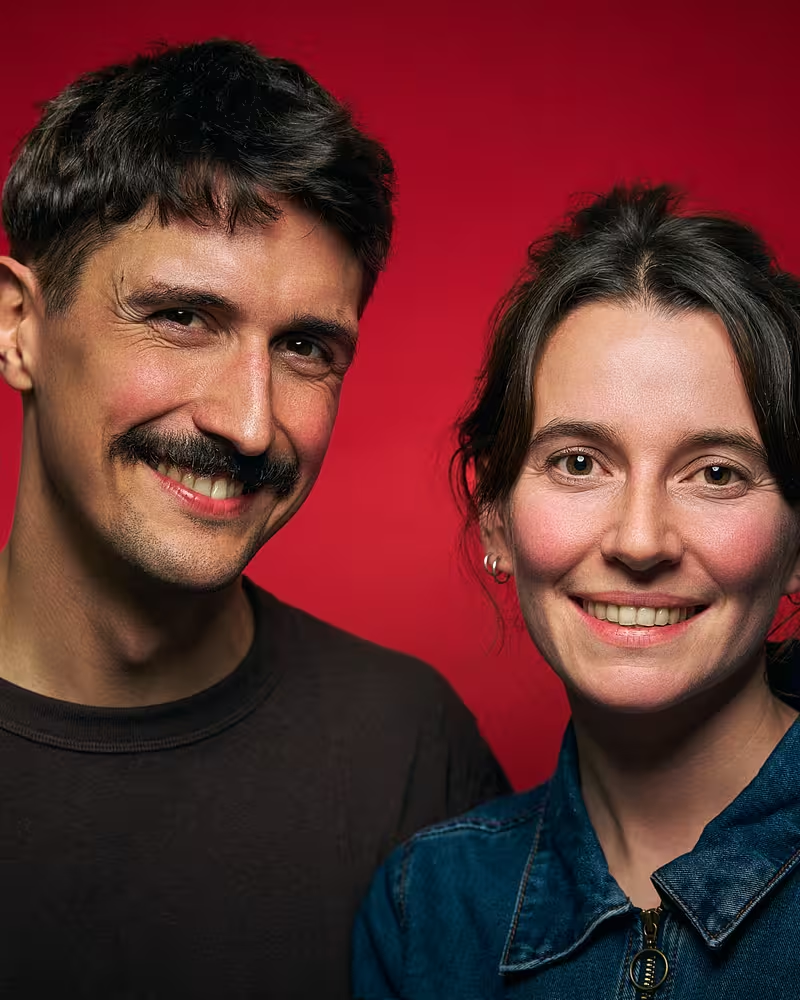
Cabeza Patata is a multidisciplinary studio specialising in character design. It was created by Katie Menzies and Abel Reverter in 2018 and has a focus on diversity and female empowerment within a world of playful characters, full of energy and positivity.
They have worked for tech giants such as Google, Apple, Microsoft and Spotify, and have done editorial illustration for The New York Times, The New Yorker, El País and Icon Design.
Talk: Exhausted … but still excited!
We are tired, new parent kind of tired, AI kind of tired, Social Media kind of tired, but still unwaveringly excited about what we’re working on.
From late-night wake ups to early-morning client calls we often find we’re running on pure adrenaline. Yet somehow in the midst of the chaos we keep finding inspiration, and realise our way of understanding and enjoying the world has changed.
We’ll talk about navigating parenthood and creative work, and discover how embracing the chaos has made us adapt and find excitement and joy in our work.
You might be tired, but that doesn’t mean you can’t be excited about what’s next!
Transcription
[Abel Reverter] Thank you.
(Applause)
[Katie Menzies] Hi everyone.
[Katie] Wow, thank you so much for coming and making it to the end of the day as well. I think we’re a bit delayed because we’re waiting for the big queues for the free drinks. So I hope everyone managed to get their free drinks and are sitting nicely.
[Abel] Yeah, I’m expecting everyone to be a bit drunk, which is gonna be good for this.
[Katie] Yeah, we’re okay with that. Yeah, the sound guy said to me before, “Are you planning on dancing too much with the headset?” And I said, “I hadn’t planned to, but you never know.” So the title of our talk is “Exhausted, but Still Excited.” And we’ve got one little reason for that that Marc mentioned earlier.
(Video playing)
[Katie] Where are we, Max?
[Max] Berlin.
[Abel] Berlin.
[Katie] We’re so excited to be in Berlin, as you can see.
[Abel] Where are we, Max?
[Max] Berlin.
[Abel] Berlin.
[Max] Berlin.
(Video ended)
[Abel] Yeah.
[Katie] We just arrived yesterday and we loved the whole airplane ride. Everything had a whole new exciting spin. We do have a bit of a disclaimer before we start the talk. We hope nobody minds, but as you can see, we’ve been exhausted.
[Abel] It’s been a lot throughout the last two years. We’ve been pretty busy.
[Abel] So let’s be honest, we didn’t have time to do a talk for this event. We’re running on 2022, but I mean--
[Katie] I think there was a lot of new faces in the crowd, so I think it should be fine. It’s fine. Please haven’t changed that much. Hopefully it’s gonna still be relevant. I don’t think that very much has changed. Okay, that was just our disclaimer, but we’re sure you’re gonna absolutely love the talk. And if it doesn’t go to plan or break into dance--
[Abel] Yeah, we’ll do something. It’s fine, it’s okay.
[Katie] It’ll all be good. Well, first of all, big congrats for everyone for voting out Trump. Whew!
[Abel] Okay, that’s a little bit confusing.
[Katie] Things were getting a bit too crazy there. And it’s just nice to know that these people are safely behind bars right now. Am I right?
[Abel] Okay, maybe this is not relevant. Let’s move, let’s continue.
[Katie] Yeah. It’s been a crazy couple of years for the world. We’re just coming out of this mad time. Like this photo sort of sums it all up for us.
[Abel] Okay, this is how it all, okay, let’s continue.
[Katie] But for us, we really feel like the real world is overrated.
[Katie] Okay, this might be relevant. It is so 2010s.
[Abel] Yeah.
[Katie] So we’re here to invite you to join us in the virtual world, everyone.
[Abel] Yes, yes, this is what we need.
[Katie] We’re here to introduce you to the future. We think that you’re the perfect audience to announce our very exclusive drop tonight of Cabeza Patata’s NFT collection. Yes.
(Audience Laughing)
[Katie] Thank you. We’ll be joining the esteemed company of-- The Spots?
[Katie] The CryptoShox.
[Katie] And you guessed it, the slimy snails.
[Katie] They are the future.
[Abel] Yes, they are the future. You pay us money, it’s very simple. You give us money, just give us a lot of money.
[Katie] We’ll all be millionaires.
[Abel] Yeah, yeah, somehow that money will turn to more money and nothing can go wrong. I mean, this is an amazing idea.
[Abel] So we’re starting to think that all of this is not the agenda well. So we want to announce that we actually made a presentation for 2025.
[Abel] That was a little joke, sorry about that.
(Audience Laughing)
[Abel] But we find interesting to revisit these topics and to see how the type of content and presentation that we were seeing back then. And it’s always good to keep in mind that, in five years’ time, you might look at some presentation and you don’t want to look ridiculous or harmful with the things you say. And that’s something we like to think about.
[Katie] Because as artists, we’re trying to make work that’s atemporal. We want to make things that could be made in the past and we’d be excited about that we’re still gonna be proud of in the future. And we want to always be excited and motivated by the work that we’re making.
[Abel] So when we look back, we’d like to analyze, we’d like to analyze the core of what will remain central in our work.
[Katie] So we want to start by telling you a little bit about us, just to set the scene for anybody who’s unfamiliar with our work. We actually met each other 12 years ago on a summer design course at Central St. Martin’s Art School in London. So art’s always been quite a big part of our relationship. Right from the beginning, this is actually what we like to call our first artistic endeavor.
[Abel] Yeah, this is a haircut Katie gave me. This is her university flat share. And she gave me a haircut. And since then, I haven’t gone to the hairdresser. She’s been cutting my hair ever since. And I think that that was the first artistic thing we did together.
[Katie] Yeah, and then as we were saying, I was at university, so we were actually dating long distance to begin with. So we would always send each other these little postcards that we’d hand draw, we’d make presents, or we’d do artistic projects together as well. So there was always this kind of artistic thread through our relationship. You can imagine we met on the art course, and we like doing these things. We’ve always just liked making art anywhere that you can imagine, and just everywhere, including out on the streets if we can. And art’s been a part of our lives before that as well.
[Abel] Yes, like we both liked art when we were little.
[Katie] And we can look at our life as a sort of before and after of Cabeza Patata. I say our life is our relationship, as the two are so intertwined right now, but actually recently, the amount of time that we spent working together has just surpassed the amount of time that we spent as a couple.
[Abel] Which is an interesting thing, because our work has been taking so much of our life that it’s kind of the time before working together starts being a distant memory that’s getting smaller and smaller.
[Katie] So here’s a bit of the backstory of Cabeza Patata, now that you know about us. We moved to Barcelona in 2016. We actually went there because I was doing a master’s in illustration. When you saw me there in the university kitchen, I was actually studying French and politics, so it was quite different.
[Abel] And I managed to get a little bit. By then, I was already doing some work in London in motion graphics, that was a freelancer there. So I was able to move with Katie to Barcelona and do some remote work.
[Katie] And we had a lot of fun there, but we found that in a few months time, only things started moving very, very fast for us. So we were all kind of settled in, enjoying our life in Barcelona. And in February 2018, we started exploring. We started doing another one of these projects, artistic projects that we like to call them. And this one just so happened to be, I was doing these 2D character illustrations, Annabelle was translating them into 3D.
[Abel] Yeah, and it was a simple exercise. We didn’t think much of it. It was just something that we were doing for fun. And they started getting a bit of attention, but we were finding something that was not kind of up to the standard that we wanted to reach. Everything was looking very geometrical. We were looking for something more tactile, related to the type of things that we liked. And I feel like this image, for example, we started kind of exploring the different materials, and we were finding things that were more interesting.
[Katie] But we weren’t quite getting there somehow. There was something that was missing. We wanted this sort of really organic feeling. And it was just a month or so later when we discovered digital clothing. And that’s what kind of changed everything for us. We were just, we happened to be sitting next to another design studio when we were in Barcelona, and they were using this program called Marvelous Designer. You can see me there making my own jacket to then put on a character.
[Abel] Which happens to be a jacket from when I was a kid. I was 12 years old, Katie founded one day in my grandma’s house. So this jacket has a lot of history, because it ended up being the jacket from one of our characters. And this type of work right now, you feel like you’ve seen it. It’s sometimes difficult to go back to only, what is this, seven years ago? And this was completely new. Nobody had done this realistic clothing with something so graphic.
[Katie] And we were excited. So from then on, it was just like a complete explosion for us, and we started making new, new images. We didn’t stop creating, coming up with new ideas for characters, and just refining them as we went. You can see a bit, the proportions are sort of changing as we’re going, and we’re trying out new colors, and we were making handmade textures, and we just didn’t stop.
[Abel] Yeah, it was so exciting. It felt like every day we were trying something, and it was looking better than the previous attempt, and it was just something that hadn’t been seen out there. We were feeling that we were making something completely new.
[Katie] And it was, at this point, we realized that we’d created this character style, and it suddenly just became hugely popular. So here we’ve got our first website that we put together with the images that you’ve just seen, really.
[Katie] And then it just happened very fast that suddenly that summer, we were invited to visit London’s Google offices.
[Abel] Yeah, I mean, it’s, imagine to go from, we’re having fun, Katie’s still studying her master’s, to suddenly, like someone at Google says, come around to London, and we went to their offices, they gave us their first job.
[Katie] We were making these lovely Christmas stickers, which actually suddenly feel quite relevant. Again, they were for Google’s Gboard, so you can actually still use them, download them and send them on.
[Abel] And it was not, this project didn’t include all the clothing and the stuff that we had been doing, but we still felt that we were applying a lot of the knowledge that we had, this tactile feeling to our character design. And we felt that we were getting a personality and way more confidence from having a big tech job that was coming to us. Suddenly, we could face next clients having something behind.
[Katie] And then in the period of a year from then, we got jobs for Apple, was a big one that came, and we did a whole bunch of jobs in different markets with Apple, and you can see that they were always interested in getting these signature characters from us, using them in the App Store all over the world, really.
[Abel] Yeah, we also got contacted by newspapers, we illustrated articles for the New York Times about fashion, we also got contacted by the New Yorker, this is all within 10 months. It was so intense.
[Abel] And in the end, the culmination of after one year of having made that website, Spotify came to us with a massive job, with a big budget, and they wanted us basically to be a different thing. They wanted us to be a bigger studio, we had to hire a lot of animators, buy computers because we didn’t have the ability to render that many things. It was a crazy project, but it went very well, and I feel that it was the project that finally established us in the industry. People knew who we were and the name of our company, and we have a reel of the project here.
(Video Playing – Upbeat Music)
[Abel] So, thank you. Thank you.
(Audience Applauding)
[Katie] As a bit of a reference here for how crazy that time was, so we went to our festival in Barcelona.
[Abel] If you don’t know what is our festival, in the world of animation and motion graphics, it’s really big. It’s probably like 5,000, 6,000 people attending it.
[Katie] So like everyone in the industry. Sorry? So like everyone in the industry.
[Abel] Yeah, it’s a lot of people. And we were there in 2018.
[Abel] This is when we just had made our website. We got on Amazon this kind of paper that you can print with your printer and then with an iron, you can make your own t-shirts. Because we were like, “Let’s make our t-shirts from Cabeza Patata so we can go around the festival telling everyone that now we are a studio.”
[Katie] So we were going around the festival and explaining to people a bit who we were, and they were kind of confused because they knew you from freelancing. I was still doing my masters. But secretly, we were working on this massive Spotify project. So we were kind of showing people on our phone, like, “You guys aren’t gonna believe what’s about to happen.” And people were like, “Okay.”
[Katie] But then next year, we came back as speakers.
[Abel] Yeah. And it’s just the feeling of like going from, to a festival of that size. As an attendee, seeing the speakers as something so far away, to suddenly have that in the period of a year was a lot.
[Katie] It was a lot.
[Katie] We also, after then, we just traveled around the world. We got so many amazing opportunities to go and talk in different places around the world. And we even got to visit big company headquarters. Like, here I am outside the New York Times. And we got to go and see them. And that was like a real dream come true for me. Kind of still pinching myself, feeling nervous and not believing it.
[Abel] Yeah, we gave lots of talks, I think, in the previous slide. You can see like us with our gigantic head. And here in Berlin, in Pictoplasma in 2019, we gave talks and we’ve given so many talks. It, throughout the years, it’s been amazing to be able to travel and to go to so many places to speak about what we do.
[Katie] We’ve also got to do exhibitions, which has been so much fun for us. And we really just love exploring, and using different kind of mediums. So you can see here that we’re painting on walls and 3D printing and doing laser cut. And we’ve even got to do mad things like have our characters life-size printed.
[Abel] In China, yeah. We model all these characters. We didn’t physically build these ones, but like they made them in gigantic form for an art center in China. So it’s like so many different projects were coming to us. It felt like our work was very, very trendy at the moment. So everything was coming. And also every time we were getting a project proposal or something, our car to design our illustrations were always in the documents, in any proposal was there. We were still doing a lot of, we love doing exhibitions and doing physical work, but definitely the 3D was driving a lot of the client work.
[Katie] We were also doing a lot of workshops around the world as well. And oftentimes teaching children, you can see here, which is super fun for us. And it was just these amazing opportunities that we were getting. That was part of the travel too. We’ve also got our own wine here.
[Abel] A lot of random things that happened. Like we basically said yes to everything that was coming to us, that was fun. And it’s like so many random opportunities. It was great.
[Katie] This is a really cool one. We actually got to go to Armenia and teach teenagers how to make 3D characters. And they made the most amazing stuff here. We’ve been there a few times since and it was just so cool. I don’t think I even really knew where Armenia was on a map before that. And now I feel like a real friend of.
[Abel] Yeah, we love going there.
[Abel] And looking back of why this style was so popular. And I think that that’s going back to this idea of trying to analyze what’s the core. Why was that working? We think it boils down to this.
[Katie] The first is that we were new and we didn’t have any preconceptions about character design. So we were just really having fun with this and exploring because we were excited about it. And the next is that we applied things that we loved from our lives. So it felt really true to us. Like I really liked making clothes for myself. I’d always enjoyed doing that and making patterns. Actually the way that I had gotten into character design really was through embroidery. And you can see here some of the embroideries was where I was learning a bit more about illustration and composition and things I think. I made these shirts that I called them tattoo shirts and I’d like put different characters all over them. And it was just a way of exploring for me really.
[Abel] And from my side I always loved experimenting. Like the work that we were doing discovering how 3D clothing was working and how to adapt this to all these characters comes from all the work I have been doing before. A lot of non-commercial work doing VR experiences. This is some of the experiments I was doing with a music video for the Beatles song and the Warlords. And I was destroying a million things. I always loved this kind of quirky, colorful style. And I feel that the character design that we were doing was mixing very well those two worlds that we had in our heads. And it was something that was not like confronting ideas. It was suddenly our brains were working together which is a very beautiful feeling.
[Katie] And right now it feels like the market is kind of oversaturated with this character style. This sort of graphical characters wearing realistic clothing. You feel like you’ve seen it everywhere and you’ve seen these colors and everything. But it’s hard to visualize that back then quite a short time ago actually no one had done it. And it was such a crazy feeling for us to think, look something that hasn’t been seen before is suddenly within a year we’re seeing imitations of it.
[Abel] None of these images are our work which is crazy. It’s like the copy got to the point of copying our patterns, copying the colors, copying everything.
[Abel] And it’s difficult. Suddenly I was in my hometown and then went to the shopping center and in the night store they had the characters that looked like ours and I was like, wow this is kind of crazy. We made a style that is kind of flattering and I said you got to be like in Airbnb arts or in train stations.
[Katie] And even in jobs that we’d turned down ourselves. It was crazy. And it started to feel a bit sort of demoralizing for us. It was kind of exhausting to see that this was how the industry worked. We were feeling like whatever thing that we would make, suddenly it would be reproduced and commercialized and it would just really have the soul taken out of it. So all of this love that we had for crafts and all of the behind the scenes embroidery and different type of tactile ideas that we were having were gone and these beloved characters of ours were just a way of selling products in the end.
[Abel] Yeah, absolutely. And I don’t know if you are familiar with the idea of the Memphis style.
[Abel] So many people, so many people online very angry about our style calling it the Memphis style of 3D. So the idea of Memphis style is this character design that is used by big corporations to kind of represent every human at the same time. So these unrealistic skin tones, these perfect scenes in which everyone’s happy. And it’s true, you know, like we cannot deny it but it’s so painful at the same time because it even can’t because we wanted to sell some Apple phone. We did it because this represents who we are and we were doing that as an experiment that we were doing with each other.
[Katie] And I honestly think that had we done something in order to try and get a commercial end, we wouldn’t have been as successful because it would have felt more forced. So it did really hurt us a lot. And so we were trying to think for this presentation, okay, how did we actually try and escape this cycle and how are we still trying to?
[Abel] Yeah, the first thing is that you have the first mover advantage.
[Abel] So a bit like in chess, the person moving first has possibility of deciding certain things. And I think that that was the case for us. You know, that allows us to position us better to get more followers, more attention just because we have been the first ones doing it. So people copying it were always a tiny bit behind.
[Katie] Another thing was we were constantly trying to change our style. So we were trying to switch it up and make new character styles. But to be honest, this is quite tiring and quite difficult, as I’m sure you can all imagine.
[Abel] It’s really exhausting. And especially, you always talk about that kind of idea of like the music band that takes 15 years to make their super hit album. And then the label says, “Oh, next year, can you make one again?” And they’re like, “Okay, it took me kind of 15 years to make all these songs. And now you want one in one year.” And it’s how it felt to us. The cart of the time we were doing was the combination of a lot of things we had been doing throughout time.
[Katie] So the next thing we decided to do was to go back to having fun and feeling excited again. So a few things that we can recommend to you. Make your own cookie cutters. That was very fun for us. We made them with our, we 3D printed them here with our character. Oh, and while you’re at it, actually, you could make it into a frame by frame animation.
[Abel] We made only one at the beginning and then we were like, “For sure we can animate it.” And it was very fun to do animation. You can, officially. Yeah.
[Katie] And then eat them.
[Katie] You could 3D print a walk cycle. That was a really fun thing for us to do. Then we can have the characters walking all over our house.
[Abel] So these are all photos. Nothing is 3D. It’s quite confusing, but each of the 3D sculptures is a position and then we swap them one by one and then you get this weird effect in which the characters are jumping from one person to another. That’s very fun.
[Katie] Also make a giant character. This one is three meters tall, kind of ended up even bigger than we were planning for it to be.
[Abel] Again, nobody paying for this. We just did it for the sake of it. I still, it’s like hit like in our house in a massive Tupperware. Yeah. Yeah.
[Katie] If anyone could think of a home trip.
[Katie] So the only problem with these things, as fun as they were, they weren’t making us any money. Yes. So we were trying to think, okay, what’s a way that we can make money, but also we can keep feeling in control. We can keep having fun with this and not just feel demoralized and exhausted by all the time. So we were having a think and our social media at that point had grown a lot. We had over 100,000 followers on Instagram and we felt like we might be able to leverage this to help us to find a new way of making a living.
[Katie] We had always enjoyed teaching, but there was one problem or one sort of challenge, I guess, that we wanted to make sure we overcame, which is that we didn’t want to just be there adding fuel to the fire of all of these characters that we were seeing everywhere and feeling really upset by, like all of this really soulless copies. So the way that we found to avoid this was making our own platform called Patata School.
[Abel] Yeah, and from the beginning, we set up some rules. One of them is there are courses. We’re gonna be based on the principles of character design. If we branch out and we teach other things, character design needs to be core, but we’re gonna be character agnostic. We didn’t want to make a factory for people to copy our characters. That would be just not useful and also people would get stuck with that. We want to kind of help people to go to the same thinking process that we need to create our own characters, but with their own kind of hobbies or whatever they like to apply to their character design. So we are not committing to a single style, but we’re constantly exploring techniques. It’s a school basically of exploration. Like if the course is even the course is very specific, it’s all about exploration.
[Katie] Yeah, and that’s really fun for us too. You can see just in these examples that we are also having fun with character design again, but it’s I think similar to when we started with Patata, it’s not with the commercial ends. So it means that everything’s quite true to us and enjoyable.
[Katie] And keeping true to our philosophy of having fun as we do it. On the day that we launched up at Patata School, we actually went to Universal Studios in LA. So it meant that whilst we were getting notifications on our phone of our new members signing up, we were actually here exploring Springfield. It was really fun. Eating crusty.
[Abel] It was an amazing day.
[Katie] Yeah, and not many people know that because we actually, we didn’t think it would be funny in the moment to tell people that. Didn’t look very serious.
[Abel] To be honest, it was really good. I remember it really well, but there was some moments we started getting emails with people being like, “You don’t accept PayPal,” or things like that. And I was like, “Oh no, it’s just, this is gonna be our life from now on.” Just like technical difficulties and all of that we didn’t have to deal with before. But it was a beautiful day. It was really nice. And I feel like we, by then, were like, have done something that was, again, true to ourselves.
[Katie] Absolutely. So when we’re thinking about how is this new business of ours different from the NFT craze? How are we not just making people feel anxious again and feel like, “Ah, I need to give you my money” so that I can get a job, “and otherwise I’m just gonna be left behind all the time.” Well, we don’t sell the promise of a job, even if a lot of people come and say, “Can you guarantee that I will get a job?” We say, “That’s a no.” But rather we sell the promise that you’ll learn. So we’re all about learning and the craft of character design and animation and 3D, and we wanna make real things that are actually relevant
[Katie] to what people wanna learn and to what we like creating as well.
[Abel] Yeah, and also we made a platform like that. We run regular live sessions and different topics. And this is something very interesting for us. I feel as well, social media right now, feels so saturated and tense in general that having a smaller community is this really nice way of having a conversation with our members in which we join a Zoom call and we are like 100 to 100 people there, and it feels really, really nice to be able to talk to each other.
[Abel] So we haven’t said no to commercial work completely. We’ve just taken away the pressure of having to say yes.
[Abel] And that’s because Patata School now offers us a regular income. It’s been a lot of work. It’s been, you know, like we have a lot of courses that we have created. This is not a sales pitch for Patata School.
[Abel] That’s not what we want to do here. But we want to kind of be honest about what it has, Patata School has been meaning for our lives. This is being a two-person business. We run everything. We do all the technical thing behind the school and we do everything that is necessary to maintain it. But it has been something that doesn’t take us five days, a week, eight hours.
[Abel] It’s very flexible and it has produced, like I kind of can never stop talking about it. But it’s like we don’t even tell our families how well it’s gone. But like I wanted to kind of express this talk that the money that Patata School has produced has really changed our lives. And it’s kind of a strange thing because we didn’t start it with that intention. But I might say it now and then in the future, I might regret it and never talk about it again. But like Patata School, each month right now is generating an average of $30,000.
[Abel] It has produced more than $1.2 million for us in three years. So it really has been transformational. It means that, you know, something that we started thinking, oh, this can be a little side project. It has allowed us to completely change our careers.
[Katie] The main thing that it gives us is the privilege of choice. And there’s a few different ways that we can implement that. The first is that we can choose any commercial projects that we like. So usually that’s the projects that are gonna take us a bit out of our comfort zone. There are gonna be things that are really fun. When people come and say, oh, can we have your characters and can they be floating with shapes? We’re like, not again. But if someone like Lego comes along and says, oh, can we do a workshop that we’re gonna film with you and then you’re gonna go into the Lego store and work with kids? We’re like, yes, definitely.
[Abel] And then that allows all the exploration. I’ve been loving exploring and getting out of, you know, like trying to do something that we haven’t done before. We always say yes, and then we discover how to do it.
[Katie] Absolutely, yeah, that definitely happened to us with Lego, because when they come and say, oh, can you do a lot of stop motion Lego? We’re like, yeah, probably we can do. And what we wanna try and keep when we’re doing these type of projects, we wanna have this sort of handmade charm to everything, but obviously we still want things to be very technically impressive. You know, when you’re looking at something, you think, oh, part of you says, oh, I could make that. And then part of you says, I could never make that. It’s sort of, it’s what, like when you’re 10, that’s how you imagine it will look. That’s the idea that it never does.
[Abel] Yeah, we have here a few examples of work we’ve done for them.
[Katie] There’s different approaches that we take to it as well. So one of the approaches is obviously leaning on what we know, which is using 3D as a reference for it. And this one is for our project that we did with Lego Botanicals, which is the range of flowers, which was a very fun one to do because now our house is full of Lego flowers.
[Abel] Yeah, so many, yeah. We don’t even have them all out. Some of them are in boxes because it’s just like so many.
[Katie] Yeah, we might start looking a bit mad if it was so full.
[Katie] But here we can see the 3D reference. And I think it’s quite fun to watch this a bit before we show the full video, just because you can see how we really did replicate.
[Katie] I mean, we made the entire storyboard in 3D, which I think is quite unusual for a stop motion. Yeah, but it’s very useful. But it’s very useful. And here we have the video for this one.
(Water Splashing) (Birds Chirping)
[Abel] There we go. And we have--
[Katie] We have another one as well that was from the same series. But this one was really fun because it was, the pitch was sort of making a bit more about us and to make an object that represented us and then include the Lego Botanicals in some way.
[Abel] I think this was so fun. I guess I still don’t understand why Lego commissioned us to make a video about ourselves that then they posted on their Lego Instagram.
[Abel] I don’t know, we didn’t want to ask.
(Laughing)
[Katie] Are you sure?
[Abel] Yeah, it was great.
[Katie] But we had a lot of fun with it and you’ve got a little guess what the object is, but I think the video will explain it better.
(Video playing)
[Katie] When we first met, we would talk about our dreams of traveling.
[Abel] Enter Bataka, our eight is camper van.
[Katie] She carries our memories and the potential for new adventures.
[Abel] She provides a space for our connection to Bloom.
[Katie] And just when we think we squeezed everything into the trunk, there still seems to be space for more.
[Abel] Through travel, our family friendships are love continue to blossom.
(Video ended)
[Abel] Yeah, there you go.
(Laughing)
[Katie] And another approach was a different project that we did for Lego and that was using After Effects, a bit of trickery in After Effects, I like to say. And this one was for a completely different project which was for a tournament of Lego which they do in the Champs-Élysées in Paris,
[Katie] which I didn’t even know existed, but it sounds incredible. And we’re gonna explain a little bit of the behind the scenes of how we made this one. This was just to invite people to come and join the competition.
[Katie] So we were making different objects to do with summer and we did a 360 rotation taking a photo. You can see on the reference here of the lines we have, moving manually each time.
[Abel] That’s one of the things that I didn’t know before doing stop motion. And then when you start discovering the work of studios in a stop motion, it’s how many things are done in layers. It’s impossible to do a lot of times everything on a single shot. So you film one thing, you film another, you film another and then you combine them.
[Abel] You’re still having the lovely movements from stop motion, but you are not having to control. If not, if you want to make one mistake, you will have to start a video from the very beginning. So we did versions of the objects being dismounted, mounted and dismounted. We then rotoscoped everything with After Effects.
[Abel] And to create the waves, we actually made them in Blender. So we got the wave effect and using geometry nodes, which is a system that you can use inside Blender to kind of play with geometry. We turned that into Lego pieces. We could have used that as a reference directly to then make a stop motion animation of the waves.
[Katie] But we’re no crazy.
[Abel] We didn’t have time. So we did that just basically rendering it in 3D. We had the reference of how it would look because we had the lighting and we had the Lego pieces. So it was all about copying that lighting, making it look realistic, and then putting it all together for the final video.
[Katie] And then we put a bit of color grading and sound effects for the dropping the Lego pieces there. And then I think we got the final idea. What does summer mean to you? For me, it’s enjoying a cold ice cream on a hot day.
[Abel] For me, scattering the perfect sunset with my camera.
[Katie] And what about building sand castles? You always need a bucket and spade for summer.
[Abel] And don’t forget your sand glasses ready for summer.
[Abel] What does summer mean? As you can see, yeah, it’s a bit disappointing now that we show you that the waves were not made of stop motion. You’re like, I can see it, but actually we didn’t tell you before, you wouldn’t know.
[Katie] And we didn’t tell.
(Laughing)
[Katie] I know, I feel bad even saying it. I’m like the person who I never liked to watch the, you know, when you’d have the DVD and then you’d have the extra making of Harry Potter or something, and I would never watch it. And you always laughed at me, but I was like, I don’t wanna see the green screen.
[Abel] I wanna believe the magic. If you keep inside, you feel like Harry Potter is all real or something.
[Katie] Yeah. Yeah, I know.
[Katie] Another choice we have is that we can choose to experiment. And we’ve got a pretty crazy example of this one, which is Mechanica. And we’re not completely sure, but we like to think it’s the world’s first robotic puppet rock band. So if anyone else knows of one, let me know, because I’ve been making that claim everywhere we go.
[Abel] So this person behind is my brother. My brother is a musician, but also a mechanical engineer. So we kind of did this collaboration that took us so much time and completely self-funded to do this robot band that we wanted to make it through to the style of Cabeza Patata, mechanically complicated, but also we wanted everything to feel very tactile and real puppets. We didn’t want to feel like robots.
[Katie] Exactly, so we used traditional techniques for making all of the puppetry. We were actually working in a studio where we had access to loads of incredible machines. And I think we probably used every single one of them. Here we are cutting all of the wood. I think you’re making the stool for the drummer to sit on there. And we were making the puppets using traditional techniques, as you can see here, making every accessory painstakingly and even using real hands with actual armatures and even if they didn’t really need them in the end.
[Abel] Yeah, we were hiding all the structures inside the clothing, as you can see in the next slide.
[Katie] Yeah, so we were mixing, but we were mixing with modern technology. We’re still gonna see the technology and then the hidden.
[Abel] It was great. It was all a lot of kind of cables and engines all working in unison. And also we did a lot of little details for the entire presentation. We had an embroidery machine that we made t-shirts for the entire team. We made a few more things.
[Katie] We were learning as we were, so this is one of the first structures we made. It’s actually the arms are made from the chopsticks from our lunch that we had. We were like, well, these will probably work. But we realized pretty soon that we couldn’t be that simple. So we got these much more complex rigs because also as we went, we were making things more and more complicated.
[Katie] I think just because we were getting excited. Things didn’t always go quite to plan. It does.
(Laughing)
[Katie] That happens surprisingly often. But once we did have it ready, this is what you were talking about. We were trying to keep all this technology hidden away.
[Abel] Yeah, it was a lot of work of hiding the technology and making some of the cards wouldn’t look too chunky with the amount of motors that they had inside.
[Katie] So once we had the mechanics ready, this is a bit of a moment of truth for us. You can see, we’re not even really enjoying it. We’re just looking nervous.
[Abel] I think this should have sound, no? Is that how we’re missing the sound on this one?
[Katie] Oh yeah, but you can imagine what the sound is.
(Laughing)
[Katie] And after the mechanics were ready, we would make sure that all the musicians were ready. So you can see every detail in the accessories. We had this sort of punky sailor in the middle was probably my favorite with her spiky wristbands and earrings and all sorts of things. We actually brought it here to Berlin. In May of 2023, we had the mechanical world premiere.
[Katie] And that was a pretty big deal.
[Abel] We just made tickets, like we made entire stage. We had like all of those LED panels that were controlled by a MIDI keyboard. It was just so much work. It was months and months of work.
[Katie] And we wanted the band to look like they were a real rock band on tour. So we took these quite dramatic angle photos as well. And even I think that this is just a lapel microphone, but it ended up being perfect for the drum. The size is so cute.
[Katie] And we had a MIDI keyboard attached so that people could control the different songs that they were playing and the lighting display and the speed of the songs as well. So it was just amazing to see people enjoy it as well.
[Abel] I think we have here a tiny video showing a bit of the band playing. The sound should be on. I think it’s missing. Oh yeah.
[Abel] It’s okay because we don’t have any kind of important video here, but just imagine it not sounding that good because it’s just a very simple robot playing.
(Bell Ringing)
[Abel] Oh, there you are.
[Katie] … there you are
(Laughing)
[Abel] And this was part of the fun of the band. It’s like so much stuff, making it look like a rock band. But in the end, it’s very childish because that’s what we could do.
(Bell Ringing)
[Katie] Yeah, but they played real rock songs as well.
(Bell Ringing)
[Katie] So your brothers are kind of rock beats. So he was like, we’ll put Nirvana.
(Bell Ringing)
[Katie] Our next choice is that we can choose how to spend our working hours.
[Abel] Yeah, and this is something we’ve been doing a lot with Bad Dada School. And I feel as well that the reason why it’s been growing so much is because we have been relaxed about experimenting, trying new techniques and trying new styles. I mean, we have what you would call competitors. There’s other people teaching Blender and other kind of schools teaching this type of things, but are much bigger. And because they are much bigger, I feel like they have like a decision board in which they are like, oh, let’s look at the next trendy thing. And if Apple makes the liquid glass, now let’s teach people how to make liquid glass on Blender or something like that. But what we are doing is just having fun and experimenting on trying things that we hadn’t seen ourselves before. This is being our obsession. In the previous slide, you can see the obsession we’ve been having lately, which is making stuff that is in 3D, but that looks completely 2D. And I think that that is really kind of the future of 3D films and animation, because I think everyone’s so tired of that kind of Pixar perfect 3D style. Also, AI has been, because the internet or the world was full of that type of 3D, the AI has been so good at reproducing it again and again and again. And everyone is a bit exhausted of that style. And I feel that these different styles, now with our sound with Max, every time I look at drawings from books that he has, I think, oh, that actually could be replicated in 3D. And then we try different styles. Katie’s so good at like drawing a million different kind of styles and very beautiful illustrations that have a hand drawn. And then we take them into the 3D world. And it’s just exploration, but we post it, we check if people like it. And then when we have enough knowledge about the technique, we make a course about it. That is the process. There’s not much kind of planning of what we’re gonna teach. It’s more we see what’s working of what people are liking, and then we make a course about it. What we are doing right now, I think in the next slide, you can see it’s like the bounciness and the doing real time simulations with all of this is something that we’ve been finding super interesting. And it’s something that is not possible within any of the software. The cool thing when you’re working with a 3D software is that you can use all those simulations, like liquid simulations and clothes simulation. And you can mix that with things that look 2D. And the moment in which we started experimenting with this is just when you are at home and you’re making it and you’re like, oh my goodness, is that feeling again that you’re making something that you have never seen before, and it’s something that was in your brain and suddenly it’s happening in the computer. And I feel so excited about this. Probably in three years, it’s gonna be everywhere. But I’m telling you now that we were the first ones checking with this stuff. It’s fine. I sound a bit angry about it. It’s okay. We are teaching it and I want everyone to do it. We teach so that it will be. Yeah, yeah. Please everyone make it. I actually want everyone to do it. And we’ve been big supporters of Blender as well because of that, because it allows everyone to join. And not only because it’s a great open source piece of software, I mean, it’s incredible. But also it really runs on every computer. Like, even if you have a computer that is up to like almost 10 years old, if it was an okay computer by then, it can run the newest versions of Blender. And everything we’re doing for the school, we make sure that we are working with not that many polygons and in an efficient way. And I love running the animations without the computer having to get super hot and running everything with the maximum number of subdivisions. And I hate that type of work. I love the work when it’s light and it just works well. I think it’s a much better way of learning as well.
[Katie] Thank you.
[Katie] Our next point is that we can choose our hours. And this is extra important to us because as we mentioned, Max was born in January, 2024.
[Katie] And a huge thing for us is that Batata School has allowed us to be able to enjoy him properly. In the past, we found that we used to work much longer hours because actually our job was also our hobby really. So it meant that sometimes when we’d get home from work as it were, we’d actually continue even working on those projects. We definitely discussed them because we were so excited. And it means that now the boundary between work and life is much, much clearer. And that’s really nice for us.
[Abel] I think it’s been very healthy. We were always quite responsible about trying to stop work, not to work until very late. And we were having, I think, a balanced life. But at the end of the day, we are a couple. And it meant that a lot of times we would go out for dinner and spend hours talking about work. And since Max came, that thing is changing a lot. And I think for good. Sometimes things overlap. We love doing artistic projects for him. So far, he’s not able to paint a wall in the room. But we’ve been doing-- He tries to help him. We’ve been painting a lot of things and doing toys for him and doing a lot of crafts. And we want him to be part of all of the artistic process that we enjoy so much. But we really believe that the time that we are not spending with him is just hours that we’re not going to get back.
[Abel] So we’ve been feeling the pressure much more of being like, OK, we don’t want to be working nonstop. And the reality is that the industry, as it is, a lot of times, it just makes you do that.
[Katie] Absolutely. We also have a dog who needs regular walks. But he’s a big source of inspiration, as you can see. So that’s all OK. We just feel like the advertising world isn’t ready for a family-run business is the way that we look at it. We find they’re always giving us this last-minute feedback, unrealistic deadlines. People will come and they’ll come like now and say, oh, Christmas campaign.
[Katie] Didn’t know Christmas was coming. We have infinite changes as well. And just none of this applies to our lifestyle right now. So we just try to avoid that pressure.
[Abel] It’s a funny thing, I feel, that because at the beginning, when you start working or when the first time we got a big project, you really believe them. They’re like, oh my goodness, a last-minute thing happened. And you kind of join them on that drama. And now, within time, I just don’t join on the drama. I see them like little toddlers crying, that you’re like, OK, when you come down, you can just continue.
[Katie] We’ll get this ready for you guys
[Abel] And it’s like, it really is-- I do understand that it’s kind of the process of the commercial world. But I think for us to come out of it has been so helpful, in our mental health as well.
[Katie] Definitely. And it’s given us a bit of a unique perspective on the industry as well, I think, because we’re able to be a bit more objective when we look at it, because-- I mean, you just called all our clients toddlers. So that might be saying goodbye to a few. But that’s OK, because we actually have the ability to step back from it and not mind too much. And from that position where we are, we see that many aspects of the current AI craze do remind us of previous movements, like the one we referenced at the beginning.
[Katie] And that feeling of anxiety and FOMO that we’re all getting, there’s like this hype everywhere that if you don’t jump into it now, it’s coming for all of us. And you’re just going to miss out.
[Abel] Yeah, this thing of missing out always makes me very angry as well, especially with AI. Because they are like, if you don’t jump now, you’re going to miss out. And you’re like, missing out on what? You know, the AI-- the idea is that AI is going to make it. So it’s going to make it for me. So I cannot miss out. If I want to use the tool, I will be able to use the tool.
[Abel] I don’t think we should make decisions all the time feeling that if we don’t do it this month, that the entire NFT craze was based on that. It was like, just do it now, because in two months, everyone’s going to discover it’s appeared on the scheme. And then-- and the feeling was like, this is not good. This is not good for anyone. This is making everyone anxious. And I don’t think that new generations getting into the industry, they need to live with that anxiety just when they start.
[Katie] Absolutely. And we definitely, within our students, we find a lot of people feeling very anxious about AI art in particular, coming for everyone’s jobs and things. So what we tell people is, look, when you’re feeling overwhelmed by whatever new technology it is, try and look back at your core values. And try and think about why you started doing what you do. So if when you were five, you were dreaming of a beautiful future of writing prompts and waiting for an image to be put out. Yeah, just go for it. Now is your time. Do jump in.
[Katie] But if, like us, you dreamed of a life of making something more meaningful, beautiful animation and characters, music, poetry, whatever it is that you’re into, then do it.
[Katie] And there’s something that the tech industry keeps missing.
[Abel] On every wave, every single time. If we’re talking about the NFT craze, the AI, the industry always keeps missing. Like all the tech people that are running all of these kind of anxiety schemes keep missing something. But instead of explaining that ourselves, we’re going to let Jorge Drexler sing it to you. Because, I mean, he sings so well. And it’s a beautiful song. So it’s only struck from it. And it’s in the Spanish, but we put subtitles in English.
(Music Playing) (Non-english Singing)
[Abel] So communication is, and has always been, part of our human condition.
[Katie] When we look at the songs, poems, or images from the past, and all around us today, also we’ll look at video games, many interactive experiences, or websites that people in this room are making. The thing they have in common is that they all connect us to one another.
[Katie] The systems might change, but the message doesn’t. So whatever it is that you’re going to go and make, just don’t forget to add some human love to it. Thank you very much.
(Applause)