Jared Ficklin
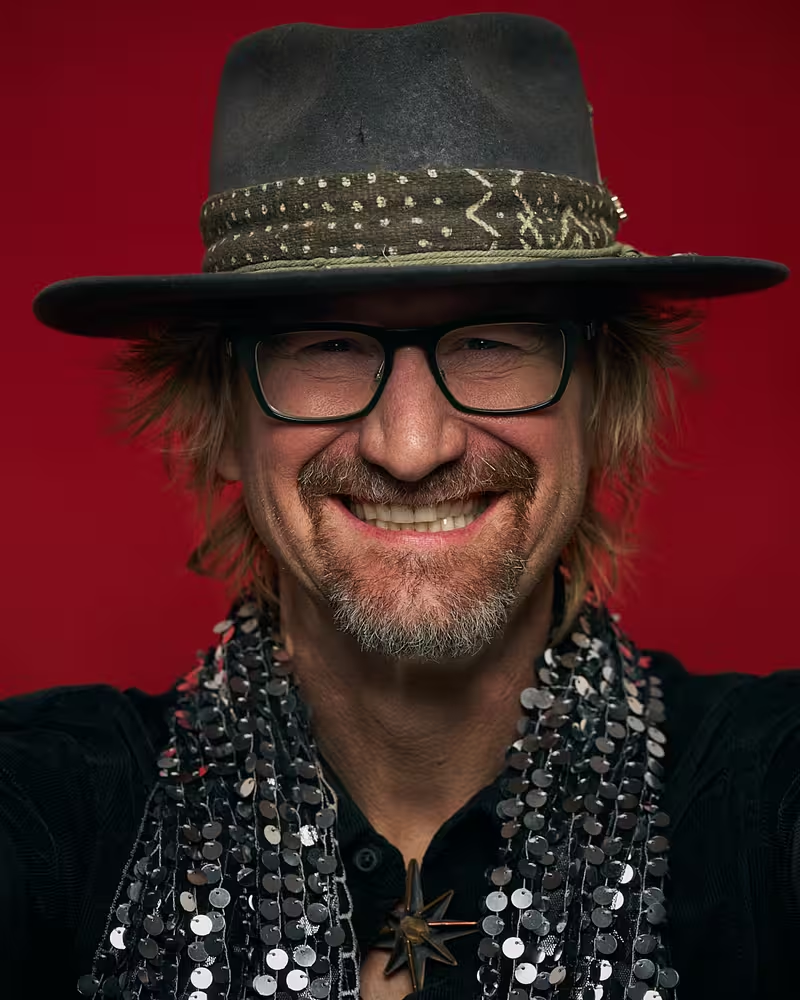
Jared is a frog fellow. He believes experience is key to design and has spent more than a decade finding value for the user in innovative technology and bringing solutions to large organizations. Every March in Austin he directs the SXSW Interactive opening party which is a large scale social experiment with a focus on technology in social settings featuring lots large scale interactive installations. He spoke at TED. He is maker. He is the co-director of Austin Public Skatepark Action Committee. He was once a cowboy in 1867.
Talk: Art in Dusty Places
Every year a city of 75,000 people is built in the middle of a dry lake bed which is in the middle of the Black Rock Desert which is in the middle of nowhere in Northern Nevada in the USA. Black Rock City exists ephemerally on a substrate of an ancient lake bed that is an unhealthy and caustic mix of alkaline salts and fine minerals laid out perfectly flat for miles in all directions. The smallest movement of air raises the dust, a breeze necessitates eye protection, a wind creates a whiteout so complete you can experience vertigo. The dust coats everything and everyone.
It is an environment naturally devoid of the influences of contour, contrast, color, liquid water, animal or plant life. In this setting humans arrive for a month of building and 10 days of existing. Then in effigy it is all burned to the ground. With no other natural influences the emergent culture is unique and decidedly humanistic. Life can become so amplified that the world outside is referred to as analog. Any day at This Thing in The Desert is a practice between survival and self-actualisation and like no other day lived. And it comes with two constants: Dust and Art.
Transcription
(Cheering)
Thank you, Marc.
(Applause)
Thank you for this opportunity to talk about my hobbies.
(Laughing)
Because usually I'm talking about the future of technology and product and making jokes about how we all believe that AI will be more useful than creating pictures of that one time I was at Burning Man with the Pope.
(Laughing)
We had a moment in the temple.
Let's start with a different joke. How do you know someone's been to Burning Man?
They'll tell you.
Let's spend an hour doing that. In 2017, I was fresh out of divorce. My brother ran Maker Faire Austin.(...) Sabrina Merlo was the director of programming for Maker Faire Austin. She was also the director of programming for Burning Man.
She had this idea. All the producers of Burning Man's across the country should go to Burning Man. So he gave them tickets.
My brother is my twin brother.
And there's this thing with twins where you give one a gift, you have to give it to the twin.
So all of a sudden I found myself with tickets to Burning Man. The first I had to get there.
From Austin, Texas to the Black Rock Desert. It's a three sometimes four day drive. I'll put this in European terms. That's like driving from Berlin to Kazan, Russia.
We got there.(...) Bright eye, bushy tail. This is a picture of us on Gate Road.(...) But there's a lot of people waiting to get in. So actually we were on that road for the next 10 hours.
Often it takes that long to get into Burning Man. So your commitment is made early. And then it was the middle of the night and we were new and we didn't know what we were doing. So we drove around and found an open spot and set up a tent. And in the morning some people came out and they're like, oh, welcome to our camp.
You're now members of the Dusty Tribe.
We didn't know you were members until last night when you showed up and took someone else's spot. But it's Burning Man.(...) So we had a tent and I made a bike. We ride bikes around there and then it was a week.
I met the man, got some cat ears, found some fur. A lot of serendipity.
Serendipity like I had brought a gift. They were little patches from a movie, The Last Starfighters, which I really love. And I had gone to a camp and met a girl and given her the patch. She started crying.
Because her dad loved that movie and made her watch it 22 times.
And he had just passed away a year earlier.(...) Only to find Thursday when I was wandering across the ply and my bike told me I needed to go to this dubstep that was happening off here in this camp. And I was dancing for a while on a speaker cabinet up in the air with a girl(...) who 20 minutes I realised was the same girl.
Serendipity, right? And it affected me. I'm not gonna talk a lot about what happened that week or other weeks. We're gonna transition to talking about art. But I will give you a taste of what it sounds like out there.
It's this mix of approximately 1,000 EDM GJs all playing at once.
And you hear that constantly for weeks and weeks and weeks unless you're in the influence of their sound. So Black Rock City is built in the desert. Here's Black Rock City overlaid Berlin.
75,000, that's the population each year. About 6.1 square miles. There are 1,700 porta-potties provided but that's it.
It's no water, no food, no shelter. Money is not really accepted except for to buy ice and all that is then handed over to the local Paiute tribe to thank them for letting us use their land.(...) It's about 440 art projects, 800 mutant vehicles and 1,500 theme camps.
What happens is four weeks before the event, the playa looks like this.(...) Then in four weeks we build an entire city.
And there is an urban area and there is a suburban rural area. Well, it's all formed in a semicircle around the man that sits in the middle.
And so there's city and country. And an interesting thing happens, this is Larry Harvey's description of it, is that when you're out on deep playa, the rural area during the day, you feel like the biggest thing in the universe because there's nothing but this flat expanse. In the winter it's a lake.(...) All the water evaporates and deposits these caustic chemicals that turn into sand. So there's really no life out there. So when we show up there are only humans out there.(...) So it becomes a decidedly humanist thing.(...) And during the day you think, "Oh, I'm human, I'm so important, I'm so big." And then at night you look up to the sky
and it's so clear because you're at altitude and there's no water vapor.
And you see the entire star field in the galaxy ring itself.(...) And you think, "I am the smallest thing in the universe.(...) "I don't matter at all, I'm merely a speck." And between those two things it's really hard not to have a spiritual experience out there.
But there's not like forests to influence culture and there's not like animals to influence culture. What happens is decidedly a humanist culture and it can be described by the 10 principles. These are emergent properties. This is not the 10 commandments. This is not how you live.(...) This describes what ends up evolving as a humanist culture.
Radical inclusion, gifting, radical self-reliance, don't decommodification, radical self-expression, communal effort, civic responsibility, leaving no trace participation and immediacy. I'm not gonna explain all of these. You could look them up or better yet, go to Burning Man and feel it for yourself.
I like this definition.
So externally,(...) when you have all this stuff together in Black Rock City and you make those principles, basically everything you need is there because you brought it. Everything you want is there because it's gifted as part of decommodification. So you're living a self-actualised existence for about 10 days. Catherine Myronik from the Singularity Institute would describe this as a dress rehearsal for a post-scarcity society.(...) That's what it really is and that's why I'm there for this social experiment, which is really fascinating.
Externally,
this looks like what do people do when they're living a self-actualised life? Well, if you were to believe the press, most of them get naked and do drugs.
Or if you believe the Burning Man org, it's all about art.
It's really somewhere in between. There, in fact, you will run into naked people doing drugs out there and you will run into a lot of art out there. But you will also run into people who decide for a week that they should be postal carriers.
I'm one of those. I deliver the mail at Black Rock City. It's really fun. They wanna run a bike repair shop for a week or they wanna be a coffee barista for a week or they wanna be gay for a week or they wanna be a model for a week. Radical self-expression is what's going on out there because that's what's left when you take about all the trappings of capitalism. I also spend a lot of time working at Globe Firm while I'm out there.(...) It's an important business.
Okay, I'm the head of sales. I have a saying.
K is for closers.
I don't do that drug, but it really motivates my salespeople for some reason.
There's also a lot of art out there. There's small art and it's an amazing medium to apply. It's this big, flat, mostly white thing so you can play with white, you can play with sculpture, you can play with reflectivity so long as you're willing to clean it off every hour
because it'll be dusty very, very quickly. There's also very large scale art.
This is the temple. It's a tradition started by an architect, David Best. It's massive. So, you know, 10 story building and it's a memorial.
It's a place for secular grief and we put things into it that we want to release. A lot of wedding dresses in there for people who've been divorced, a lot of pictures that recently deceased and then at the end of the week, we burn it down.
Everyone knows we burn the man. A lot of people don't know we burn the temple and it's an incredible experience because you have 70,000 people sitting about a quarter mile away because that's how hot it gets in perfect silence
except for the occasional sob.
And so after that experience, I came home, I was like, "You know what? I want to go back. In fact, I want to go back every year for the next 10 years and bring art." So, to bring art to Burning Man, first you need an idea.
Well, to do anything creative, you need an idea.
You need a crew. It's really hard to do a lot on your own out there because you have so much to take care of. You got to get tickets. That's the really hard part. But bringing art out there helps you get tickets.(...) You need approval. Burning Man is often confused for anarchy. It is not. It's one of the largest bureaucracies in the world. Actually, we should say ad-hocracy because every bureaucracy is staffed by volunteers, thus it's staffed by people who care about it the most.
Which is really interesting. It's a lot of paperwork and forms and then you need to work really hard, right? So, I formed up a crew and I named my camp The Last Starfighters after that original moment of serendipity.(...) And in 2018, we brought out the augmented reality porta-potties.
Which is something I had done before because I figured, "You know what? I got a lot to master. Let me do something I've done before." I activated these at South by Southwest. I brought them to conferences. They're really fun commentary on the intersection of technology and humanity and you could say the line between information and too much information is longer than the line to these porta-potties.
But projection out there, I was like, "That won't work. Too much dust."
And so, I did what everyone does. I tried to raise some money. It doesn't work. You end up spending your own money on this stuff. But that's what hobbies are for. It's okay.(...) And I started prototyping and I wanted to do this. I was like, "Let me escalate. Let me turn these into roller-blind signs, which are those things that are on buses or the side of a football field." Except for they don't sell them in very large formats. They sell them for buses and football fields. That's the only place they're used. So, I was like, "Okay, I'll build one. That seems easy enough. It's not easy. It looks easy." But it turns out as the paper rolls up, it changes the diameter of the wheels and everything binds up. And so, I had to do a bunch of Google research. Eventually, I figured out you have to have one-way cams and some special gears and all this. You got to put the motor in the right place. And then I realised, "Oh, how the heck am I going to mount this on a porta-potty?" I was like, "I can't just go to a construction site." And I just, "Hey, can I borrow your..." So, I bought a porta-potty.
(Laughter)
Proud owner of a porta-potty. It costs about $600 US and they will deliver them. And I guess there is a business that can follow that. I don't know that I wanted to be in that business. So, I kept going. I figured out how to mount the thing to the porta-potty. And I found a bunch of open source images of people sitting and standing and a great image of the whole playa. And I plotted those out and I found out... plotters are great to have, by the way, if you want to be creative.
You can buy vinyl that's waterproof and it's really tough. And then you could add sensors to the back to stop it at the right place. And you could figure out a real quick kind of French cleat to hang it on the door. And then you move to scale.
I had to mill a whole bunch of parts because the parts for those special gears are not the same as the bike chain I wanted to use because the chain for those special gears is really expensive. So, I made a bunch of little parts to put it all together. And then, one of the greatest tricks in art is if you do something once, OK, that's good. If you do it three times, you're like, "Eh, you're kind of copying yourself." But if you do it ten times, it becomes a new artistic statement. So, I was like, "I've got to do this at scale. I'll do ten porta-potties." That way, more people can experience. Luckily, I have my twin brother, the dude.
He's a carpenter, and so he helped make things all the same size, the same shape. He's part of my artist collective, which is two people that we call the Other Singularity. As in, you've heard of the Singularity?
Well, what about the Other Singularity?
So, there he is. And he makes sure to put the man on everything. And then our crew, we all learn a lot of things about tools. And then you pack it up in a trailer really, really, really nice(...) because we're Ficklins, and that's what Ficklins do.
And then you take it down the road,(...) and you wait and gate, and you find out that if you go early to set up, gate is only two hours. What a nice perk.
You set up your tent, this time in your own camp, because you've been placed. And then you go to artery, and they tell you where your artwork would be. Every one of those dots there is a work of art, big or small. And the red ones are going to be burned down sometime during the week. It's exciting.(...) And then you meet with someone, and they have a fun golf cart that kind of looks like a, I don't know, skull rabbit thing that's weirdly anatomically correct.
And they go by GPS coordinates. They drive out where your art's going to be, and they circle the porta-potties, and they circle the porta-potties, and eventually you tap them on their shoulder, and you say, "It is the porta-potties."
And they go, "What? Your art is the porta-potties?" And you say, "I know, it's a really shitty medium."
(Laughter)
And then you hammer your little floof in the ground, and it has a CD with your coordinates on it, and they will keep track of your art, and they are adhocracies. They will come out multiple times a week to make sure it's lit, safe, and clean.
And you're like, "OK, I better do this right."(...) You don't want the porta-potties to look all dingy, so you wrap them in vinyl, matte vinyl, because it's going to get dusty anyways, right? And while your crew's doing that, you're back in a six-sided tent to make sure none of that copper wiring gets on the Playa, and you're running tests.
Here's what they look like when the porta-potties empty. It's a panorama of the Black Rock Mountains, which are the mountains behind the porta-potties. I was like, "How meta?
Look at the port mountains while you're looking at the mountains."(...) Empty Playa, empty potty, right? Of course, I needed to test this at altitude and temperature, so I wrote a little algorithm that would just run them for 24 hours. I waited for each one to break, and I fixed what broke, and I'm like, "That's great, they'll work all week."(...) Right? Did that in a clean room. Hmm.
(Sighs)
Then the wind starts blowing,
right when you're on top of the porta-potties, creating a wiring harness.
And you take a couple pictures while it's clear, but this is what it really looks like.(...) When the wind blows, it picks up the dust, it creates a white-out. You can't see your hand this far out of your face. So all the goggles and masks you see people wearing at Burning Man, they are fashion accessories,
only because they are necessary accessories, and you want them to look stylish.
And you end up with an augmented reality porta-potties. Kind of looks like an art gallery.
And I never did get the full panorama because the org would not let us rearrange the porta-potties. They also would only let us use the color blue.
Right? And here's how they work. You go in, and then I'm standing.(...) There's a little sensor
that measures the distance to the back wall so that it knows I am now sitting.
And now I'm standing again.
And then it's done. See, it's not augmented for the people on the inside, it's augmented on the people on the outside, because you would say, "If you'll give me a little bit of your privacy, I'll give you a feature."
And everyone needs features.
No one needs privacy. At night, they lit up. You could see them from a mile away, like these kind of standing soldiers out in the middle. Sometimes they were lit up by fire because it's Burning Man.
That's a mutant vehicle. There's quite a few of them out there. They cannot look like their original donor vehicle.(...) And they're everything from Pac-Mans to giant moving castles to just lights and magic. And what's great about them is they bring participants. And everyone would walk up.(...) And first they'd be like, "It's really a porta-pottie!"
Which is good, because if you're out in deep playa, you could be a mile from another porta-pottie, and they're really happy about that. And then they go in, and then everyone outside kind of giggles.
(Laughter)
And they come out, and they're like, "Why were you laughing?" And they're like, "I'm not going to tell you."
These people were waiting for their friends, and they're like, "Good time to throw a rave. Let's do that."
Yeah, it's always a good time to throw a rave at Burning Man. This guy would show up every day at 4 o'clock, and I was out there checking on the porta-potties, and I listened to him for about 30 minutes, and he described to several participants what the artistic expression meant about the augmented reality porta-potties, and what a bunch of work he went through to create them.
(Laughter)
Especially attractive young burners. And I went to him, and I was like, "That's really cool." I was like, "Did you ever think about this?" Or maybe it was a little more of a commentary on this, and he goes, "Wait, are these yours?" I'm like, "Yeah." He's like, "Awesome! I've been telling people they're mine all week! Do you want a beer?"
And he goes, "But then the dust comes. The dust always comes, and the dust...
I mean, it can hide you, but it can break you, and it certainly broke these, right?" And so I would ride out there, it was a two-hour commute every day, and check on them. Sometimes I would find them like this, I would fix them, and they were like this because of this, the dust.
But not just the dust, there's violent temperature swings from over 100 degrees Fahrenheit to down to like 40 degrees Fahrenheit every day, and it turns out wood and metal and plastic all expand at different rates, so it was literally breaking everything apart. And I would glue it back together and tension the chains, and I had a whole crew of starfighters to help me do that, to keep it running, and these guys here who keep them clean, they visited six times a day. These were the cleanest porta-potties on the Playa, which meant people started riding two hours just to use them.
Right, and eventually, the Mayan Warrior came out, 20,000 people held a rave near them, and they were all broken, so I just set them to a photo gallery, and they lasted till Thursday, which is probably a record for electromechanical, interactive art on the Playa, which is very, very hard on electronics.(...) And they just sat there for the rest of the week.(...) And then I had fun, met the man, got some gifts.
We'll talk about that. You can ask me later, I'll tell you some of the things that happen.
That year, it was extravagance. The Playa provided me with such extravagance that year. It was amazing. And then you take it all down. You literally sweep the Playa, because we must leave no trace,(...) and you do the same for your camp.
The BLM, which is the Bureau of Land Management, who manages public land in the United States at the end of the burn,
about a month after we get rid of the city, will come out with 12 sheets of paper, and then they will select 12 acres, acres at random.
And then they will pick up every bit of trash on that acre, and they will transfer it to that sheet of paper.
And it cannot completely cover the sheet of paper. It must fit on the sheet of paper.
So when we say leave no trace, we mean leave no trace.
Literally, 75,000 people leave, and they cannot fill up 12 sheets of paper with the trash we leave behind.(...) Otherwise, they would not renew the permit. So since 1986, this has been happening with no trace left behind, and they do keep track of it. If you're one of those little red spots,(...) it's not like they chastise you.
They just quietly don't invite you back.
2019,
ah,
Playa is such a big place. I want to do something big. It's one of the pleasures of doing art there, is you can do giant scale things. So I'm like, let me do the trailing soul, because I'm a Taurus.
And Taurus is like the plan everything. So my hardest principle is the principle of immediacy. I was like, ah, I want to create something that examines that. I had this idea of like a trail of light that would follow someone and represent their energy as they moved around the world. And so I think creative endeavors always start with a prototype. I think they always end up with three iterations. The first one tells you how it's going to work.(...) The second one gets it working. And the third one kind of revines it until it's about 80% of your vision. If you try to capture that last 20%, often you never finish. So I prototype, prototype. I like doing found stuff. I went to Home Depot and found a bunch of gate hardware. And I was like, oh, that's great. And I was like, oh, you can link them together. If you link them together, they kind of make a big snaking thing. Oh, that's an inexpensive way to make something really large. I was like, ah, I'll buy enough of these to make it 100 yards long. And then I got a sewing machine and taught myself just enough sewing that I could make all of this.(...) I realised, eh,
that kind of looks saggy. So then I squished it down. I was like, oh, that looks like a shark. Sharks are cooler than saggy things.
And it had this kind of really nice repetition. And it moved like a living, breathing thing with the wind.(...) So I was like, ah, we can make the lights living and breathing as well,
which was lucky because these whip lights I found for ATVs and Doom buggies had that mode already.
And I was like, oh, yeah, paperwork.
Got to do a bunch of paperwork. So I created an application for the art, created a budget, created a project plan. And they do want all these documents. And they do all of them, all of this detail, because by the time you get out there, they want you to just be setting it up. They want you to succeed. And so they force you through the steps to succeed. And art also needs these steps to succeed, especially when it's in a public forum.
And then you have to get a place to live. So placement, you got to get a whole map of your-- everyone's going to live. And then, oh, that's check, check, check, check. That helps you get your tickets. And then you're like back to building.
So you realize this is going to take a lot of patterns. 225 amps per section, six sections. I need a battery carrier. The batteries weigh 65 pounds each. That's 135 pounds of battery times six.(...) And you're like, OK, I'm going to build about a sixth of it, test it at Maker Faire, nice smooth ground, test well. But then, oh, it's really heavy. Humans can't carry it.
So redesign the battery box, buy an air tug. An air tug is an electric tug for moving aircraft around an airport.(...) It can pull 10,000 pounds.
I was like, that's-- and it's whisper quiet. I'm like, oh, this is even better than humans pulling it. Let's get one of those. And then your eyes go wide because you move to scale and you're spending a lot of money at this point. You're like, geez, I hope this will work.
And you get your crew and you have work days and everyone kind of channers the inner factory worker because you're like making six of everything, six of everything, six of everything. But it's fun because you're working together and you kind of have this like purpose, even if it's a made up purpose to go to Burning Man, right? And you just make a whole lot of this, a whole lot of that.
Start running out of space to store it all in your little garage and you start thinking about building a larger shop.(...) One of the reasons that people love this little community that you build is because they get to learn new things like how to use a cold cut solid metal or the number of people I've taught to weld or we've all like learned a new tool together. It's really fantastic. And you test, you test, and you test and you build because you don't build on the Playa. You set up on the Playa. The Playa is four hours away from the nearest hardware store and six hours away from the nearest Home Depot.
So you set up and so you build and test at home and you like decide, you know what, I don't want to run six generators. Let's run this off of solar power. So you build a solar power system too.(...) And your brother makes all kinds of fun Starfighter logos for the side of it so you can put lights in them and the solar panels will be really pretty and part of the art.
You put chargers on everything and then you make a carrier for your tug because you don't want to run the battery of your tug for that one mile journey out to the thing and then you test it because you set up on the Playa. You don't build on the Playa. Often in our creative endeavors we leave things far too much to the last minute. By the time you're showing it to a customer you should merely be setting it up and focusing on the story. You should not still be building it one hour the night before.
And then you realize safety third. Like you've created something and you've tested something and then one day it pins you against the wall in the garage because you put the throttle up too much and if someone else hadn't been there you would still be pinned to the wall of the garage and you're like, fuck, this thing's dangerous.
So you build a throttle limiter and then you realize that if it got away from you nothing would stop it. It would just keep going until it hit the black rock so you build a safety release. And you're like, holy cow, solar power is always on, always live so you build shut off the chillages and you pack it very neatly in the trailer because you're a Ficklin.
And then because you're a designer you make sure you have color blocked your trucks with their trailers.
You weigh everything because the DOT does not play the safety third game. They say, no, no, no, safety first or you get a $20,000 ticket. So before you get to the Playa you really do need to be mindful of those things. Fill up with water, go out even earlier, see that the city hasn't even been built yet and set it all up.(...) And you're like, oh, thank goodness,(...) no dust.
No 35 mile an hour winds while you set up. And then you have something beautiful. And don't worry, the dust will come.(...) The dust always comes and it settles equally on everyone. It doesn't matter if you're Elon Musk or just little old Jared Ficklin. The dust equalizes everyone.
You discover that you literally have to bolt it to the Playa so it doesn't blow away, but you're really happy that your Doom Buggy lights do not snap.
Then somebody drops this off at your camp and you're like, okay, that's kind of a fun prank, let's do something with it. Let's name a Joe Q. Burner and let's put him at the front of the trailing soul when he's sitting there. And he kind of becomes a thing and you go out there and you find people having conversations with him.
He's a good listener. He gets all kinds of gifts.
But this is a piece of moving art. It's meant to represent the light and energy of a person moving across the Playa. So we call someone an apparition and each night an apparition would come in about 9 p.m. and we begin walking around the Playa.(...) So there's our apparition and this behind her represents her light and energy as she moves throughout the world. We all, as you move throughout the world, leave a trail of light and energy. Only the highest of impests really notice it. And everyone, a burning man in the modern burn especially, they're like, oh, Diplo's playing at the Mayan warrior. I got to get there. They're riding their bike across the Playa and they're already there until and they're just blowing through everyone's energy until they reach her energy because it's made physically manifest and it's 100 yards long and it takes eight minutes to pass by and now they have a decision to make. Do I go this way? Do I go that way? Do I stop there back here?
They are now in immediacy. They are present and you can see it worked quite well. These people are deciding what to do and some people turn. We'd hear people say things like, oh, man, me and my campmates, we went out to the Playa alchemist temple and half of us went right and half of us went left and we didn't see them for two days.
Each night we'd have a different apparition. They chose their own theme so here's more of my campmates.
One guy was like, hey,
fuck you, man. I was using that to navigate home.
There's not a lot of landmarks so you pick a work of art and that's your landmark how to get home but this one would move around.
And then we realised, well, he wouldn't do that twice. He didn't mean it that way. He meant fuck your burn which is kind of a greeting we have out there. He was using it to navigate home every night so you want to get home. He'd get to some brand new experience so he loved it. Here's my brother walking around, the dude has some sort of like shaman doctor who and then me and another campmate, I mean, dressed as solarians we would call this. By then we were brave. We would go right through these dance camps and just like purposely split people up and circle them around and some people literally like just sit down and like bow. We had helpers because things really long and it doesn't quite track perfectly so if you like miss your turn it's not like you can back up 100 yards of trailing soul.(...) It's really hard to go backward in your life anyways. It's really much better to commit to going further but what's useful is to have a community of people that when you get off track can lever it on the track so you don't just like tear someone else's art.
And then here we are on Friday night. We kind of made a Mad Max sort of a theme and we're like, oh, let's go to Gastown.
Luckily there's a Gastown at Burnery Man.
All kinds of fire and that's the temple that year like a series of Torrey Gates standing proud.
2020 sucked because it was canceled.(...) It was like it doesn't have to be canceled for me. I want to go to Burning Man anyways. I created radical stillness. I took the boxes from the augmented reality porta-potties and I created a bunch of images of people's Burning Man memories from the camp. And I put them in there and then I made a little platform that would measure stillness. There's a bunch of sensors underneath it and you stillness is a proxy for meditation and so that if you sat there what would happen is the units accumulate stillness and if you move they lose stillness.(...) And if they accumulate enough stillness you're transported to the playa via this panorama. And I set it up for people on the day of the burn would have been. We all went out in the field and broke a bunch of lockdown laws and said screw you we're going to burn.(...) And we did.
And I've activated in this a lot of places.(...) And people have trouble with it for two reasons. Like they're like sit still. I've seen people like reduce to tears because you just don't sit in your daily life and they don't have a practice of meditation, right? But also because I put a logarithmic rhythm to it. So the first five kind of set up a pattern but they're each getting longer and longer and by the fifth one it goes past the just notable difference.
And so when you expect it to go it doesn't. And then people tell me they have this intrusive thought which is oh I'm doing it wrong.
Which if you work out to a full sentences I'm sitting still wrong.
Which is an interesting thought. And then it moves and they're like oh all I have to do is sit still.
And I'll get to the end of this.(...) And they do and it takes about two and a half minutes to go from the second to the last minute to the last unit. But if you get past the fifth one I see everyone make it to the end.
Which she's about to do successfully.
So like House of Beautiful Bill's News had this big conference. I was like okay I'm going to do some performance art with this. And I set it all up to take a full hour because they were going to do an hour of silence. I said you know while you're doing the hour of silence and we're going to get about 4,000 people or 400. I can't remember which on a Zoom together and we're all just going to be silent together for an hour.(...) I was like okay I'll do that as Solaria.
And so I sat there for a full hour wearing this mask which weighs 15 pounds and about five minutes in I was like oh shit.
My neck is killing me. I didn't know I haven't done any preparation for this. And 400 people are watching me so I can't really like get up and abandon it.(...) But somehow I got through.
Right. It's just discomfort right. You'll be in the middle of a creative endeavor and be like doubting yourself and thinking I made the wrong move or I didn't do it. Well guess what. You can. All you have to do is just push through. 2021 was also terrible because it canceled the burn again and this time I was like I don't even want to do anything and then I remembered I had canceled things. This was the Zen gardener who was going to autonomously rake a Zen garden as you meditated on its action in order to follow the laws of as three laws of robotics as laid out by Isaac Asimov and that was going to burn it into the burn and never happened. This was messenger. There's two London telephone booths connected by full scale telephone wires so that you could go into one and talk to the person in the other.
And then it would like light up and go back and forth so you could see someone having a conversation from a great distance. They'd use words of commodification. It would print out a little fine. They would have instructions about how you needed to go to a random camp and like find a random object as penance for being commodified on the plow.(...) Or the Wisp area which we're going to be like music boxes for spoken word, right. 2022 they're holding the burn. I'm like you know I'm going to go deeper. We learned a lot of lessons about solar power doing the trailing soul. We failed miserably by the way. Like half the time we were charging the batteries in camp with the generator. We realised that for artists electricity is hard.
So I put on my product design hat and I was like you know what I'm going to study this problem. Art is beautiful.
Wouldn't it be nice if it was solar? Help the burn become more sustainable?
Solar panels are not beautiful. Even though we tried to every time I took a picture I never saw the trailing soul here. I just saw the solar panels. I was like gosh if everyone's going to convert to solar like these little red generators expanded to 100 square footage of solar panels. I'm going to use more solar panels than are out there.(...) And so it doesn't scale and then the artists have to require you know mechanical electrical engineering. They're always on. People can shock themselves. Most of the time you've got to bring an extra truck to bring them out along with your art project and that is a fume ecological disaster.(...) Aesthetically they're problematic. They're very sharp corners.
So I was like you know what let's create something we call the solar library and we'll create a library card where artists can apply for that library card so they know that they have charging infrastructure.(...) And then instead of buying a generator they'll buy batteries right and they'll use the solarium code in order to learn how to make battery powered art rather than generator power and then they can check their batteries in charge them all day and check them back out.(...) And then I'll use my product design to make an infrastructure so that it doesn't last 15 years so someone doesn't just buy a solar system and then throw it away the next year because at that point you really should just use the generator. You've got to do the full math on this stuff. If you're not doing the full math on this stuff you're just switching systems
right.
And that system better pay off otherwise you should have just stayed with the original system right. And then you create a whole new guild of volunteers that you call the solarians because like role play is fun.
And you build a plan and a roadmap and then you build it.
I don't trust my welding so I hired a fabricator to do the welding but my crew we did all the painting and the assembly and we had to have a warehouse because it's hot in Texas in the summer and I bought a forklift because these things weigh a hundred pounds each.
And at the time there was a construction boom going on post lockdown and there's a six month waiting list to rent a forklift so I was like I'll buy one.(...) Luckily it fit in my garage.
I actually think this photo defines me as a person.
Right. And then you print out all the library cards you pack it up really neatly in a truck you make sure that the color of the trailer matches the color of your truck and you ride to the burn.
You take it all apart.
You set it up with help because they weigh a hundred pounds each and you couldn't get your forklift out there because your forklift weighs 12,000 pounds.
And you have the solar power library which is essentially porta-potties for batteries.
I guess I have a small obsession.
You give it the lights of the sunset and the sunrise right and you're like you look at that and that looks like a sunset and on the back it purposely casts these rays of lights to look like a sunrise right and the artists come in and they place their batteries they turn off for safety they charge them up and they come and pick them up at the end of the day. You got to think a lot of the people who helped you get there because you never got it there yourself. Artery and the Burning Man org themselves helped us get there with a small grant.(...) The dude, my brother,
without his carpentry skills we could never move to scale.
My wife Sparkle Bunny and my daughter LaSophie who's my camp director and my inspiration for all things the last starfighters themselves, the solarians who maintain the panels all week. If you don't clean the dust off they lose 80% of their charging capacity because dust.
It can hide you but it can also hide you for the sun so you really do need to clean your stuff every night and can't use a lot of water so we do it with baby wipes.
Heat,(...) which is heavy equipment operators who donate their time and their equipment to do things like lift heavy units and ass, which is art support services who supports all the artists out there and they have a saying and the saying is all artists get ass.
Floyd the flipside warehouse that was donated to us for our build, all the artists who took the brave step of converting to battery powered art and there's been many of them.(...) And community creators.
People like who put the kings like this together, like they give you inspiration and the motivation to share and the ability to learn and the ability to cut your teeth taking a bunch of head equipment long distances.
This is me and Brighton with a whole bunch of equipment about two decades ago for flash on the beach and then you like it's really good to like kind of like record what you're doing for portfolio posterity not just for yourself and your ego but so that you can remember and use it in the future.(...) And also so you can educate others and so they can understand were you successful and we were successful at removing a lot of fumes spilled fuel from the playa and for at least six projects they didn't have to have solar panels right next to them and then you make plans for the future because you know like if something was successful maybe like and you're still passionate about it maybe keep doing it right maybe refine it figure out ways to make it better scale it up right so 2023 we was the year I was like you know what(...) let's do this whole library but also the whisper right so we went out there we set it up now we have a gantry crane so we don't even have to rely on heat we save 10 more gallons of diesel right and then we put the whisper out front here they are giant flowers made of antique gramophone horns and here's how they work when you turn the handle they play spoken word
this is Maya Angelou
one of the poems about eight minutes long
this
is an interview with Larry Harvey about 15 minutes long this is an interview with Hugh Hefner founder of Playbook Playboy magazine it's a really good interview I think there's a lot of misconceptions it's about 25 minutes long and then the last one over there the one this guy's cranking right here it's all eight hours of Stephen Hawking's Cambridge lecture series so the fun thing is if you stop cranking it goes back to the beginning because the cacophony society which are anarchists in San Francisco had a hand in the start of Burning Man so there's kind of a prankster culture out there that was my prank and you'd see people crank and they go oh check this out you crank it and they're like here I go back to the beginning like shit then people would start team you go out there people like four people they like okay go because they just wanted to hear the whole thing and some people out there they have the attention to try and make it through all eight hours of the Cambridge lectures here and the dust came and then there was a surprise rain came and not rained during the burn for 30 years and we got about five inches of it and we all trumped around and it's like clay slip it's both slippery and sticky at the same time we're all wearing plastic bags because they build up these platform shoes that weight about five pounds and we really didn't move for like the number of days but it was oddly beautiful and it washed the dust off of everything and all of a sudden the muted like everything all the colors shined again it's really interesting how colors and individuality and expression are just related to each other however the Wisperia turned out to be rain catchment barrel so they're all dead now and rust happened and when we say leave no trace we use mean leave no trace we literally scoop that up put it in a bucket and took it home with us right and now while I'm very happy that Diplo and Chris Harock got out of the burn by walking the rest of us just sat on the front porch and play guitar I think he was really motivated because he had like he was gonna make $350,000 DJing the next night and watching DC so he wanted to get out there and that burning man he doesn't get paid he just gives his set to the whole community there's also no schedule so you don't know when Diplo is playing you don't know when anyone's playing you just have to be there and of course we save more fumes 2024 I took a break I had this idea that I wanted to get this one very specific picture that represented what I wanted the future of my life to be and this was that picture in order to orchestrate this first I had to meet the most beautiful woman in the world that resonated with me also went to burning man fall in love with her ask her to marry her she had to say yes then we had to plan a letting build it eventually you got the picture but my brother because I had built a community took the solar library out anyways and we saved more that year 2025 or like that scale this sucker up we beat most of the problems that's make it bigger than ever before and so yeah we packed it up in the trailer rode through gate checked in at artery got another one of our pictures out there and we expanded our community that's snail Rob snail Rob's from outside of Denver Colorado and he worked with as an artist two years prior and then the apprentice the next year and now he built his first branch of the solar library so if we ever can't make it out there he'll take his branch out there we hope to have four branches and serve 200 artists by 2030 if you read the plan slide very careful but why did we choose to work with snail Rob well one he showed the same passion and that's important when you're collaborating it's right if you have disparate passions it doesn't really work out really well and the second is he really knows how to pack a trailer it's practically a fickling so we made modular boxes so set up and take down was easy because you don't build on the playa you set up on the playa right you have to be ready to go by the time you get out there and(...) it was really you know pleasant during set up don't worry the dust came the dust always comes this time it came in the form of 75 mile an hour winds that lasted for two hours and pretty much tore up everything because we were right in the middle of set up so we were all running around remembering that moment when the dude had told us you know you should have a strap right there listen to the dude when he tells you have a strap right there like you may think you know a lot but when someone has spent their whole life doing things like you know rigging like the dude has like it's important to know where your limits are and where other expertise begins right so together you make things better so then you just take a big breath remember that you're a burning man dance a little bit and like you asked for this this was the adventure you wanted it's not a disaster teach a bunch of new artists how to charge their batteries and end up with the biggest version of the solar library yet give it a nice rhythmic you know thing use the golden mean you know so that is resonant with people you know unless you want to provoke dissonance why provoke dissonance that's what aesthetics is all about beauty is something that you feel it's not something that you arrive at so big you could see it from space not really that's a drone shot continue the motif of like repetition you know repetition is an amazing way to take an artistic statement and like I said earlier five is an interesting statement thirty starts turning into a new interesting statement right you know enjoy the time at the burn with your crew keep it clean these above thank the artists for their participation as well(...) see some art ride some bikes burn it all down clean it all up put it on the trailer
pick everything up because you want to leave no trace right don't do things that(...) poison the environment you were just in leave it better than you found it or at least in the same state do it again next year thank you
Thanks
(Applause)