Lucy Blakiston
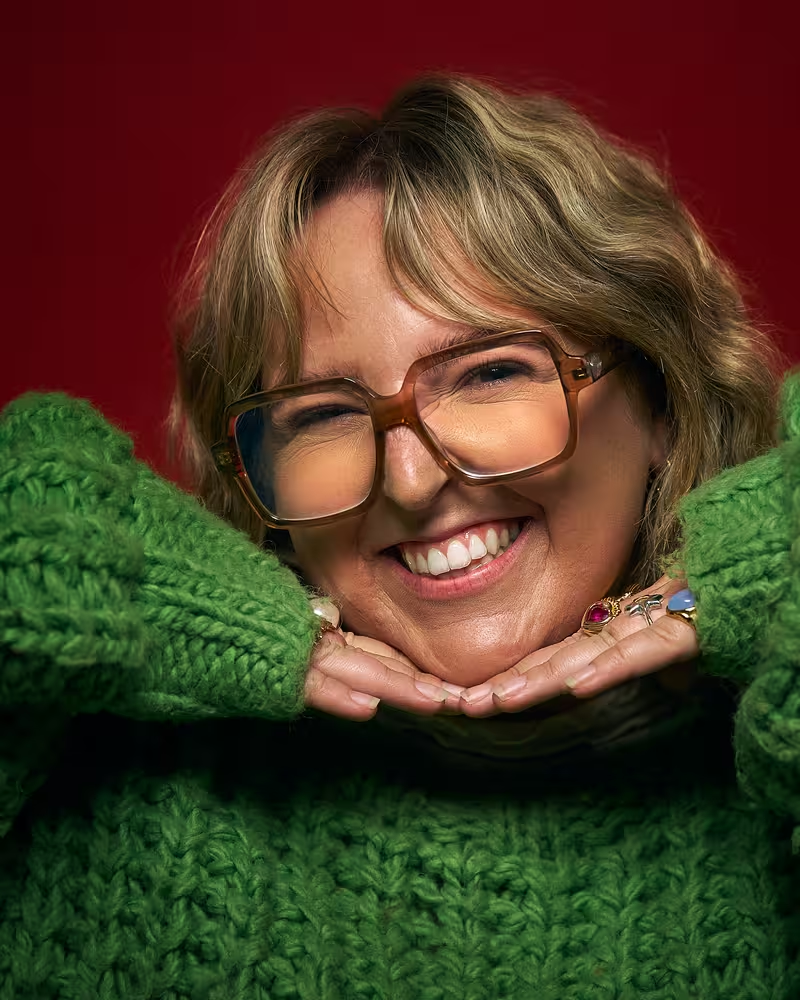
Lucy Blakiston is an author and creator of Sh*t You Should Care About aka SYSCA, a global multimedia phenomenon that cuts through the jargon and clickbait to make news accessible and entertaining, for all.
With a unique pull on Gen Z, SYSCA has a highly engaged audience including 3.4m on Instagram, 370,000 subscribers to their Substack newsletter (72% open rate) and across their their two podcasts, Sh*t Show and Culture Vulture, all of which include fun dissections of global news, pop culture commentary and more.
Lucy shares her unique insight into brand-building and Gen Z audiences through her speaking and consultancy work. She states: “At Sht You Should Care About we whole-bloody-heartedly believe that we should all be able to understand the news and the world around us because it’s happening to all of us. So that’s exactly what we help to do. We cut through the bullshit, the jargon, the clickbait – all of the shit that makes information feel inaccessible – and make it accessible (with a few Harry Styles pictures thrown in there for good measure).”*
Talk: Shit You Should Care About
You know how some chats feel like they’re being held hostage by a PowerPoint deck? Well, this isn’t that. In this chat, Lucy Blakiston – co-founder of Shit You Should Care About and author of Make It Make Sense – is sitting down with her long-time friend and fandom expert Sacha Judd for a conversation about the internet, identity, and everything in between.
Together, they’ll dig into:
- What it actually means to live online in 2025
- Why building for community matters more than chasing clout
- The fandom-to-founder pipeline
- How digital media survives (or doesn’t?) in the age of AI
Transcription
[Sacha Judd]
Are we on?
[Lucy Blakiston]
I think we're on. Hi. I feel like everyone can hear us.
[Sacha]
Yeah. So I wanna start by giving a massive shout out to Andrew in Scotland, who is going to have to spend the next 45 minutes dealing with not one, but two New Zealand accents.
[Lucy]
Yeah, I honestly have been thinking about this, and how I need to speak slowly. We'll try, we'll try. We will try.
[Sacha]
If we become incomprehensible, just shout out. But I will start by saying that when we talk about shit you should care about, we abbreviate it to SYSCA, S-Y-S-C-A. So that's specifically for poor Andrew, who might be going, what are they saying?
[Lucy]
Also I've heard that SYSCA, not spelt that way, means like boobs in Russian.
[Lucy]
So I have had a few moments of confusion between the accent and the abbreviations. Anyway, we will be fine, we will get through this. It's such a joy to be here. Everyone here is so cool. This is one of the coolest conferences I've attended. So shout out Marc, honestly.
[Lucy]
What a kick.
(Audience Applauds)
[Sacha]
So can I just have a quick show of hands how many people have heard of or are subscribed to SYSCA in its many forms? Yay, okay, we have got some readers in the audience, and they will know that today is a big day for SYSCA, so we're gonna be getting into it.
[Sacha]
I came down to breakfast to find Lucy blowing up her business over emails, so we're gonna talk about the hard stuff. But let's start with a bit of context. How did SYSCA start?
[Lucy]
Okay, well, Shit You Should Care About SYSCA is a news platform that helps, I want to say young people, but it's actually not, it's just anyone understand the news, because the news is hard and happening to everyone, and we all deserve to understand it. And so I was in my third year of university in 2018, and I was studying international relations and media studies, and I'd been there for three years, and I had spent so much money on this degree, and I still did not understand what the hell was happening in the world, because it just didn't work for my brain, it was black and white, there were such big words like hegemonic discourse and things like that. I was like, okay,
[Lucy]
I didn't know any of my friends around me that were going to desktop websites to read the news, and I was like, how is the news gonna work for us? It seems crazy that a 20-year-old was sitting there thinking I should change the news.
[Lucy]
So I text my two best friends, Ruby and Liv, and I said, I think we should start something called Shit You Should Care About to help young people care about things in a way that isn't gonna cost a lot of money to get behind a paywall. We were at university, we didn't have that kind of money, we wanted it to be for people that didn't know these huge words because we barely knew them and we'd been at university.
[Lucy]
And from there we started a blog, but 2018 blogging was kind of already dead, so I was like, oh, maybe we should put this on Instagram.
[Lucy]
Fast forward to today and the Instagram has about three and a half million people that read the news from me on there, and I have a newsletter which is my baby and my favourite way of giving people the news because we will come to find.
[Lucy]
It's famously not controlled by algorithms or what do you call them? Landlords. Corporate landlords. Corporate landlords.
[Lucy]
And that has about 400,000 daily readers. And so it's become this big, beautiful baby of mine that is a joy to do. It's such a blessing to be able to doom scroll and feel like you're doing something about it every day. I love my job so much, even though the news really sucks, but it's my job, I always say, to give you the news without giving you the blues. And so it's just a real joy to be able to do that, and it takes me places like this, my first time in Berlin,
[Lucy]
and what Sartre was referring to this morning was that Metr or Instagram or the gods that run it, not gods, what's the opposite? Demi-god, no, Devos? Devos. Don't know.
[Lucy]
Had made it so that basically news platforms like mine that aggregate content and add commentary apparently aren't adding enough commentary and they--
[Sacha]
Let's just unpack that for a second. It's okay to share news from other sources, but in order to comply with their rules around fair use, is that where it's coming from? You have to add your own commentary or your own take.
[Lucy]
Yes, which I think makes sense, it's great. You shouldn't be taking people's stuff without changing it and adding something, but it turns out that they really hated everything I'd written about Zoran winning in the United States, and seven out of 10 of the things that they'd flagged for me this morning were things that I had actually written that were from me, that I had, honestly, it was like, fair use because it's from my brain, and they flagged them, and then I made a post saying, "Hey, Instagram's taking my stuff down. "Come and follow the newsletter," because that is not controlled by anyone. As soon as I posted that, I get a notification that says,
[Lucy]
"Hey, your account will no longer be shown to anyone "that doesn't already follow you." And so I just sent out a newsletter being like, "Elon Musk can be a trillionaire, "and I can't post about the news on Instagram, "so I'm so glad that we get to talk about it on stage today. "I feel like it's very fitting that this terrible thing, "maybe it's not so terrible. "Instagram doesn't pay me. "I don't care too much about it, but yeah."
[Sacha]
Yeah. It's so big day for the Siskahood. Big day for the girlies.
[Sacha]
So let's go back in time a little bit. Siska was born in quite a different era of social media, and so how have you seen that change and your approach to it change as you've kind of moved through these different eras of corporate control, but also the way that you tackle presenting the news to your audience?
[Lucy]
The first big thing was in 2020, I decided that my news shouldn't be hosted on platforms that I don't have control over, so I started the newsletter in 2020, which was in hindsight such a good decision because now when things like today happen, it doesn't really matter. All my income comes from people paying to subscribe to the newsletter, and that's amazing because the news is still free. That's like my whole thing, but--
[Sacha]
That means that you don't put the news behind your paywall.
[Lucy]
Yeah. The news isn't behind a paywall, but you can just pay for it because you love it, and enough people love it that I can make a salary without having to do advertising, which I'm quite allergic to.
[Lucy]
And then the next big thing that changed was everyone,
[Lucy]
everyone, every platform wanted a pivot to video. Everyone wanted short form video, but my favorite thing was keeping young people reading, and so I really resisted and still resist
[Lucy]
sitting in front of a camera and making a 30-second video about the news that leaves out all the important stuff. And actually, in fact, I was anonymous for about the first five years.
[Sacha]
Yeah, I was just gonna say that. No one had seen your face on that account until you wrote a book.
[Lucy]
No. Until I wrote a book and decided, let's just do it all at once. You can have my innermost thoughts and my face. No.
[Lucy]
No, and I think that decision was so deliberate because it started in this age of influencers, and Kim Kardashian was on Instagram selling waist trainers and appetite-suppressing lollipops and things like that, and I said to my two besties, I was like, do we know who runs the BBC? Do we know what they look like? And they were like, no, and I was like, and does it matter? And they were like, no, and I was like, cool. We will never, it will never be about what we look like or what clothes we're wearing. It's about what we think.
[Lucy]
And that's one of the things that I think I'm most proud of is people can even meet me and have never seen my face, but based on the way that I speak and the vibe I emit, they know that this is me. And it's just really cool to have done that via writing and not based on putting my face on everyone's business all the time.
[Sacha]
Yeah, I think Cisco's voice has always been really human. It's funny and it's kind and it's grounded. How do you protect that in an online environment that promotes outrage and anger and conflict?
[Lucy]
So, enragement is engagement.
[Lucy]
And as someone that works online, I do need engagement, but what I do is I've created something called a mundane poll where every day on Instagram, I post something that's like, hey, do you think milk is sweet or savoury? And I let people argue in the comment sections about something that's not hurting anyone's feelings. And it's almost like I'm wrangling children and being like, argue here. Don't argue about that thing that's gonna hurt a whole community.
[Lucy]
And so I try to let people get their outrage out in one spot that never works.
[Sacha]
What was your most controversial mundane poll?
[Lucy]
Oh, okay.
[Lucy]
Not that controversial. Oh, I found out people do not change their sheets very often.
[Lucy]
Like it was like, do it every week, every two weeks, every three weeks, every month. Every month had way too many votes for my liking.
[Lucy]
But I think another way that I can handle it is like,
[Lucy]
I just for some reason don't really care. Like the online world still feels a bit fake to me. I think I have a really good in real life world with a great support system that the, cause the amount of, when you have 3 million people reading your opinions, it's in a lot of them are about Trump. You're going to get trolls and you're going to get people that just hate you. And I'm just like, I don't know anyone in my real life that's sitting there commenting nasty shit. So you don't really exist to me. And I think that's, I don't know. I have object permanence. I'm like a baby. If I can't see you, you don't exist.
[Sacha]
You and I both came up through online fandom in different areas. What skills or instincts do you think you brought from that to Siskin?
[Lucy]
So I loved, still love One Direction and Sasha had an amazing talk that a lot of people actually come up to me and said that they remember.
[Sacha]
beyond tellerrand.
[Lucy]
Yes, at this very conference about One Direction.
[Lucy]
And as I was watching her talk yesterday, I was thinking about how we both learned how to be a person online because of fandom. But yours was building for like web one or building for the internet. And mine was I learned how to be a person on social media because of fandom. And so I learned how to edit because I was reading really shit fan fiction. And it would be like, okay, there needs to be a full stop there. There needs to be a comma there. And then like Photoshop because I wanted to put myself in a photo with Harry Styles and it was like never very well done. But then also I feel like I learned, you know how AI is really mystifying right now. And you're like, is that real? Is that fake?
[Lucy]
You could see when other people would Photoshop themselves in really well with a member of One Direction. And I feel like that's why I learned how to tell what was real and what was fake.
[Lucy]
There was a lot of like, this was when Twitter was huge and I learned how to.
[Sacha]
Well One Direction was sort of the first big social media band, wasn't it?
[Lucy]
Like they were coming up on social media at the same time as I was like learning how to use social media. I had a fan account on Twitter that had about 60,000 followers. And I was thinking I was 15. And it was all about posting like funny memes and updates about One Direction. Which is what I do with the news. I post funny memes to help people understand the news and updates on the news.
[Lucy]
And pictures of Harry Styles. And still pictures of Harry Styles because we do need to have a wee ode to our roots.
[Lucy]
But yeah, I think I learned how to see something that could go viral. And back then it was for a fandom. And then now it's for the news. Both of them I still think have such, I'm not gonna say equal, but huge places like online. And I do think when I was younger, my brother was a huge fan of cycling. And he would watch the Tour de France and get up at midnight with his friends. They would have a sleepover. They would buy the Lycra and the merch for their team. And it was really cool that he loved the Tour de France so much. But when I was getting up to watch a new One Direction video or buy their merchandise, it was so embarrassing. So I think growing up and seeing those two, the way that I was treated versus Nick, and then he went on to get a job in a bike store. And if he wanted to, he could probably have become a commentator. Whereas for me, it was like, well, all those skills are useless. There's no jobs for me.
[Lucy]
I think reframing that and being like, actually all those skills should be on your resume was a really,
[Lucy]
and you helped me get there, a huge unlock in the world of the internet.
[Sacha]
And you still use that pairing of pop culture and news. And I know that one of the most frequent comments on the Cisco account is, this is not shit anyone should care about.
[Lucy]
Do you play unoriginal as well? Like they think they're the first person to ever say, this is not shit I should care about.
[Sacha]
Yeah, when we're millions deep in it now. But I think one of the interesting things you did this year was when you were posting pictures of the Met Gala, which is a common one to produce that response, right? Why am I looking at these incredibly wealthy people in beautiful dresses? This isn't shit I should care about. And this year you did something quite different. Can you tell the audience what you decided to do with the Met Gala photos?
[Lucy]
Yes, so I love fashion. The whole point of shit you should care about from the very start was that we are humans, we're interested in so many different things. You can care about the news. You can also care about Harry Styles. You can care about Formula One. You can care about like-- The Tour de France. The Tour de France. You can also be like standing up for things you believe in. We contain multitudes, right? And this platform should feel human. So it should reflect that and it does. And so for the Met Gala, I love celebrities and I think they tell us a lot about the world, but also I don't like the idea of them all just gathered in one place when a lot of shit's happening in the world. Anyway, so this year I spent a few weeks, it was actually very easy to collect really depressing and bad headlines. It's sad how easy it was. And then every single photo that I posted of a celebrity at the Met Gala in their amazing outfit had one of these headlines over the top of it. So if you were looking at one thing, you were also having to look at the other. And honestly, I think next year we will see so many people doing that because it just, you couldn't comment anything bad. Like you couldn't come for me and say, this isn't shit I should care about. Cause I'm like, girl, I'm giving you both. Like I'm giving you both, like just like it and share it.
[Lucy]
But yeah, that was one of the, it wasn't that deep and it wasn't that hard for me to think of, but because I work on my own and so I don't and I never took investment or anything. So there's no one breathing down my neck. There is no-- Except meta. Except meta, but fuck them.
[Lucy]
And there is--
[Sacha]
Sorry, Marc, for swearing.
[Lucy]
Oh yeah, sorry, Marc. And I do love you, sweet boy.
[Lucy]
There is no one having to approve things that I post. There's no friction between me and the audience.
[Lucy]
I can clap back in the comments if I want. I just think there's something so wonderful about I never wanted to scale up. My job is not to manage a team, it's to be able to be the writer and be the creator and do these things like I did on the Met Gala, which was actually funny because I was invited to an event to watch the Met, it was like a watch party. And it was all these influences all dressed up in the bougie outfits and me sitting in the corner like on my laptop, nose in the laptop, writing about all the influences around me and also like making this, it wasn't controversial, but it was funny that I was like meant to be posting really amazing stuff about the Met Gala instead. I was like, oh, but dystopian really?
[Sacha]
I mean, one of the things I was talking about yesterday is taking back control of our feeds and our attention. And there's a really active Discord server that we ran at Grey's for all the people who are building custom feeds. And these are just people who wanna find out more about it. And when I was posting about how I had improved my social media experience by creating a custom feed that was just all the things that I wanted to see, someone in that Discord sort of called me out on it and said, but surely in this current moment when there are so many awful things going on, nothing but horror everywhere we look, don't we have an obligation not to sort of shut ourselves away in a silo of niceness?
[Sacha]
And my response to that was, I can get plenty of information about the horrors anywhere. I want my time on social media to feel joy filled and interesting and like I'm learning stuff from smart people. I don't want it to be a constant kind of wave of negativity. How do you think about that balance?
[Lucy]
I think about it very similarly to you. I think it's my job to filter through the horrors and make it, I mean, I've given myself this job and I love doing it, but I filter through and again, I try and make it so that you're either reading the newsletter and you're not feeling like shit at the end of it, even though we've talked about some really hard stuff, or you're on our Instagram page
[Lucy]
and you've read three really bad things and then suddenly it's like, okay, let's have a brain break. Here's a mundane poll or a photo of Harry Styles. I think it's like, I'm a big believer that you do what you can with what you have and that's like physical things, like if you can show up to a protest, you show up to a protest. If you can't, you share something online. If you can give money, you give money. If you can't, you go and find someone, you go and find a petition to sign or whatever and I just think if everyone is really depressed about everything, nothing is gonna change. It's not good for anyone, so I always just come back to we are all doing what we can, well, all the good ones, are doing what we can with what we have and that is enough, like beating yourself up helps nobody and also people like the person in the Discord server, I'm sure they came with Grace maybe, but calling others out for being online in a way that works for them, it doesn't help anybody either. I'm not interested in online debates with people. I'm just, I just think that's giving space to nothing positive.
[Sacha]
True story. So there's a big shift from, I guess, building up this following, which I know with COVID happened very quickly for you, but there's a difference between building a following and leading a community, I guess. How have you thought about that shift?
[Lucy]
It's so much better to have less followers.
[Lucy]
I think building the following in a way is the easy part. Well, it was. Most people wouldn't say that. I know, I know and it's a real stupid thing to say, but building a following is anyone can choose to follow you, but it's like keeping them there and engaged and for me, like interested in words instead of images on a photo sharing app is, that's the hard part. And so leading a community, I think it's the best part of the job and people used to tell me that I was wasting my time by, at the very start, I replied to every single DM and I still reply to every email that I get in response to a newsletter.
[Lucy]
Unless it's like really mean or whatever. Oh no, usually I will respond to that as well.
[Sacha]
Sometimes you just post the mean ones, which is much funnier.
[Lucy]
If you're really mean to me in the emails, I won't dox you, but I will post what you've said to me. No, but it's so funny also, like if someone emails you or comments something mean and you just say, "Hey, did you forget I'm a person, xxx or something?" They will immediately go back and say, "No, I love the rest of the stuff you do. Like I'm so sorry." Like as soon as you remind them you're a person, they usually like, "Oh, like I was a bit too online."
[Lucy]
What was it? Oh yeah, so building, people told me I was wasting my time by doing that. And I would just say like, "Well, cool. All I have right now is time." Like it's COVID and by having like a back and forth with someone, it's making them feel like seen and heard. And I do think that's a part that a lot of people sort of miss out on. Like they start getting the following and then they're like, "Cool, I'm weirdly like so much better than everyone now." It's like, "No, they followed you because you are just like them. So why don't you just remain just like them and talk to them and try and take it offline where you can." Like it's hard because 50% of the audiences, of my audience is in the United States. I'm obviously in New Zealand, doing stuff offline is quite hard, but just talking to them like they're people because they are, it's like the easiest way.
[Sacha]
So what is the cost of being always on when you're both a brand and a person or the brand is the person?
[Lucy]
Well, I think the easy thing to say is like, the job is never done. You don't have a time that you log on and log off. Like Sasha said this morning,
[Lucy]
when Instagram made these changes, I was up at 5 a.m. being like, "Okay, well, how can we turn this into lemonade for me?" And it was amazing. I posted something and was like, "Don't follow me on Instagram then guys, come to the newsletter." Boom, thousands of new subscribers to the newsletter, but you have to be like awake and have a coffee. And then we like, okay, I'm thinking immediately, which I'm lucky because my brain is like that.
[Lucy]
But at the same time, I was in bed last night at like 7 p.m. because the job is just never done and it's usually in the mornings I like to do it. But like, okay, for example, one time I was at this like beading class where we were making necklaces and I took two hours on a Sunday away from my phone and I got back on my phone and there was just all these messages. And the one that really stood out for me was like, this was to my personal Instagram. "Hi Lucy, the US just bombed Iran." And I was like, "Okay, I've taken two hours off and you're coming to my personal Instagram to make sure that I know." And also obviously my news apps were buzzing, but I was like, "No Lucy, you can talk about that later." The news can wait. The news can wait because there are other really brilliant journalists covering it as well.
[Lucy]
So you're never offline, but I also think I'm really boundaried with my phone. I'm not on it that much. I love being in the real world. I love reading. I'm a very like normal person. And so I don't think getting sucked into all of the, well, it's so weird because you get treated like press and like an influencer at times.
[Lucy]
And you're around all these people that like my values don't align with a lot of the people I'm in rooms with sometimes and so yeah, it's just staying normal, keeping your same friends, like going home, living in New Zealand helps. Cause it's like... You can touch a lot of grass in New Zealand. You touch a lot of grass.
[Lucy]
Exactly.
[Sacha]
So, Cisco has been a real cultural landmark for Gen Z in particular. Like I always describe you as a Gen Z media icon, but you're obviously growing up alongside your audience. And what do you think that means for how the brand has to evolve or will evolve, you know, with the brain rot alphas coming along behind?
[Lucy]
Yeah.
[Lucy]
Honestly, I don't, I think when I started Shit You Should Care About, I made a point to like go and the New Zealand media industry is small and really kind. And so they sort of met with me and taught me how they did things. And every single one of them was like, how do we reach the youth? How do we like basically abandon our current audience and like reach for the youth? And I was thinking, okay, first of all, just hire some youth. Second of all, like why are you abandoning the audience that you're serving quite well? Like, yes, advertising money, X, Y, Z. I understand it in theory, but I'm like, you do a really good job at serving the people you serve, focus on them. You're allowed to like reach for a younger audience, but don't try and pivot everything.
[Lucy]
So I think learning from them, I was just like, I want to grow up with my audience. And if young people come and resonate with it, amazing.
[Lucy]
But I'm not gonna abandon the people that have literally grown up with me online
[Lucy]
from someone that they didn't know the face of to someone they now know like everything about
[Lucy]
to try and go viral on TikTok or, you know, so I, yeah, I'm really content with serving the people that find me. Again, it's so easy to say that when the people that find you is like millions of people.
[Lucy]
But I'm very, I love it when people unfollow me because there are so many other places that they can get news. It does not have to be me. And I like to weed out the bad ones.
[Sacha]
So for Indian media, the economics are obviously pretty brutal. Yeah.
[Sacha]
What are the models or ideas that give you hope?
[Lucy]
Subscriptions give me hope because as I said earlier, I really, I've never been good at advertising. I've never enjoyed advertising. I wouldn't pose with a product or anything like that. And so the advent of things like newsletter platforms that let you make money off your writing was brilliant for me in saying that it is so hard. It is so hard, one, to funnel people from Instagram to your newsletter, two, to funnel them from your newsletter to becoming a paid supporter. It's like such a long game. And even I never saw "Shit You Should Care About" as a business at the start. So I did it for free for about three years. And by then we had millions of followers and I met a mentor that was like, "You should be making money off of this. "You do this job for free for millions of people." But it's so hard because when you do a job, like give people the news, if you want to start doing advertising, people do not warm to it. And so you're like, "So do you want me to do this for free forever? "'Cause I can't, I have to pay rent." So there's a real, yeah, I found that a real tension. So when subscriptions sort of became a bigger thing, I was like, "Okay, this is the way I can resolve "this tension."
[Lucy]
It's definitely my favourite way of making money because people just pay because they love what you do. It doesn't feel gross.
[Lucy]
But I also, I do love doing a bit of consulting for like other media brands, sort of older ones that, again, they want to reach young people. And at the very end of our session, I'll say, and to conclude, just hire us. Like just hire young people.
[Lucy]
But yeah, it's pretty brutal. In New Zealand, we've seen our journalists be just like layoffs after layoffs. So I feel very lucky that I came up in a time where I never, I never ever considered having, oh, I may have considered it like a desktop website.
[Lucy]
I always was sort of a platform that was everywhere,
[Lucy]
which is interesting because again, after your talk, the idea of the internet kind of got too big that it started sucking. And now everything looks the same and feels the same that to actually have a website would be amazing.
[Lucy]
But changing the behaviour of young people to like log on and choose to go to a website, I don't think that would work for me yet. Yeah.
[Sacha]
And this is the thing we were talking about yesterday, right? Like we're so used to now existing in this handful of walled gardens, like how we even begin to change behaviour to say, hey, you can come over here and experience this content in a different way.
[Sacha]
And we were talking at breakfast about maybe the interim step as some of these apps or tools that aggregate from different sources, right? So maybe the starting point is getting off a platform and putting your newsletter feed or your social feed or whatever into one place.
[Lucy]
Yeah. But I just wouldn't do that. So I'm like, how can I expect young people? I mean, I could be the person driving that change if I... No. But yeah, I think like changing the behaviours of young people is so hard that the least I can do right now is just make good places for them on these platforms.
[Lucy]
And right now that feels like my job. Ask me in five years. It's a big step, yeah.
[Lucy]
Except for today on Instagram because they don't like me anymore.
[Sacha]
So you've turned down commercial partnerships in the past when they haven't aligned with your values.
[Lucy]
How has that felt? It feels amazing. I think I am not money-driven at all. So, I mean, you need it to run a business, but I'm just people-driven. I care about the people reading the stuff and how they respond to the stuff more than how much I'm getting paid for it. And so it feels really good to turn down partnerships or like I remember when Biden was in office and the White House wanted to work with me on his first 100 days or something. And I just thought like, no.
[Lucy]
And it seems bold to be this little New Zealander being like, no, I want to cover it in a way that I want to cover it. I don't want to put hashtag ad White House, no way.
[Lucy]
And so it just feels so good. I love saying no. I love being underestimated and I love saying no because I'm always in rooms with,
[Lucy]
you know, I'm about to, after this, be on a panel with the CEO of Time, the economist and the independent. And I know that on this panel, I am gonna walk on stage and people are gonna be like, what? And then when I open my mouth, they'll be like, well, hopefully they'll be like, she actually knows what she's talking about. It's one of my favourite feelings in the world, walking into a room and watching people slowly understand that you really deserve to be there. But it takes a lot of confidence to get to that point. You have to have a few like, why am I here? Why am I here? And then suddenly you're like, because I deserve to be.
[Sacha]
Amen. As you think about AI content, what's your gut reaction as that starts to creep into both the news and also the platforms that you're operating on? Okay.
[Lucy]
God, I hate generative AI.
[Lucy]
I just...
(Laughing)
[Lucy]
I just think there is no world where we need to see like an animated cat riding a unicycle with a baguette. Like there's just, I just, I really, really hate it. And you can spot it from a mile away, but there are tools.
[Lucy]
I think there are a lot of like AI tools, not with writing. I still think I would never trust anything to write in the vibe that I write in. But I made the mistake once of saying this on a podcast. I said, yeah, but like I'm so weird and no AI will ever be able to copy my tone. One of my readers went away. They asked me if they could. And I said, yes. And for their like project to get into university, they downloaded a hundred of my newsletters and made a language model.
[Sacha]
Which trained a model on it.
[Lucy]
Which trained a model that could replicate my tone of voice based on me saying, no one will ever be able to do that. And to her credit, it did it pretty well. It was a bit racist and it said stuff that I would never say, but the tone of voice was kind of slaying.
[Lucy]
And she got into her university course and I ended up publishing her research because I think that's very cool and a very bold thing to have done.
[Lucy]
But in terms of writing, I won't touch it. I was saying to Sasha this morning, my favourite thing, and I wish this existed when I first started on Instagram, is there is now an automation where if someone, you guys probably all know this because you work in industries that probably built this thing.
[Lucy]
If someone comments on an Instagram photo that I've done and they post and they comment news, it will send them a link, it'll get them to opt in and send them a link to the newsletter. And so it's helping me take people automatically away from Instagram, which is probably another reason Instagram hate me.
[Lucy]
And like every time someone new follows, it will send, maybe some of you have followed me today and you've been like, you're not messaging me that because you're on stage. When someone new follows, it'll be like, hey, this is loose, Instagram's fine, but our newsletter is way better, here's the link. Tools like that, because I used to manually tell people to send me their email and I'd get thousands of people and I'd have to put it in a spreadsheet, copy and paste it. And I did that because building a community is very important to me. But now, six years after I've started the business, these tools make it so much easier for people to opt in and get to the place you actually want them.
[Lucy]
But yeah, no generative AI.
[Lucy]
That's, I hate it. It gives me the ick.
[Sacha]
Yes, so what does success feel like for Cisco as you think about the coming year?
[Lucy]
It always just feels like me being able to still do this as a full-time job. I think that will always be the metric of success because it lets me do really cool things and it lets me travel and meet amazing people. But at the end of the day, what I like the most is sitting in my bed or at my desk and writing the news and writing to my people.
[Sacha]
So you're not aiming to hire a fleet of Cisco journalists or anything?
[Lucy]
No, I think there are amazing journalists doing amazing work and they should be funded properly, particularly in New Zealand.
[Lucy]
But I am not interested in taking over the world. I don't wanna manage a team. I just wanna write the news and kinda wanna get off Instagram. So that's what success will look like for me when you no longer see it.
[Sacha]
Successful theme.
[Sacha]
So what advice would you give people, particularly young women, thinking about starting a digital project now?
[Lucy]
Don't kill the part of you that is cringe. Kill the part that cringes. Mm. I think like...
(Audience Applauds)
[Lucy]
I'm like quite a weird person and I really do think like not being afraid to be perceived as you are and not being afraid to put yourself out there in all your weirdness is the recipe and being obsessed.
[Lucy]
Like that's the recipe to being able to do something online because if you're fearful,
[Lucy]
then you'll think about posting something for five days and by then it's irrelevant. The moment's passed. Yeah, and so you just have to be willing to throw so much shit at the wall that something sticks and that means really not being afraid to put yourself out there and like leaning into your cringe,
[Lucy]
being a fan of the things that you actually love and not being afraid to be loud about it, like X-Files or whatever it was. I don't even know the X-Files, really, but...
[Sacha]
We are definitely from different generations.
(Laughs)
[Sacha]
I discovered this morning that Lucy only knows David Hasselhoff from the SpongeBob movie.
[Lucy]
Yeah.
[Lucy]
I literally, he was like a human jet boat or something in the SpongeBob movie and I was like, isn't that like his thing?
[Lucy]
So yeah, I just think like be cringe, be loud,
[Lucy]
don't... Oh, and like find ways around the algorithm. Don't be afraid to speak loudly about the owners of the platforms that you work on. Like I, to be really candid, Meta have wanted to do a partnership with me for a long time
[Lucy]
and they have just dug themselves into more and more of a hole and then this morning I just torpedoed it. I sent out a newsletter that was basically like,
[Lucy]
if I, it's kind of holding me accountable because if I ever went back and said yes to a partnership, 400,000 people would be like, excuse me and link me to the thing that I just wrote. So I think just being brave online in whatever way you can,
[Lucy]
being brave, being cringe and being obsessed.
[Sacha]
What's one corner of the internet that feels really alive to you right now?
[Lucy]
Junk journaling, like scrapbooking and junk journaling. Is like the other day at breakfast,
[Lucy]
I took all the scraps that I had found of things that I'd done around Berlin or from a hotel is bright pink and everything is so perfect. For me, that I would like steal all the little things from the hotel room and being able to just like sit at breakfast and get my glue stick and like paste it all into my notebook and write little notes.
[Lucy]
That and then because I am-- That's a really offline thing though. Yeah, but I have a compulsion to share it. So I have a compulsion to share everything, which is why I'm perfect for my job.
[Lucy]
So it's like I watch other people's work online, like you watch book binding videos, I'll watch scrapbooking videos and then I'll go and I'll do it and I just, it's really good for my writing, it's good for my brain and it's a part of the internet that is so cute and I love it and so niche, but I'm obsessed.
[Sacha]
I was gonna ask you what your current obsession was, but I think you've just answered that one.
[01:43:12:03 - 01:43:48:21]
[Lucy]
Joint journaling, Harry Styles will remain an obsession. I also just saw the new Frankenstein movie and I'd never read Frankenstein before and I'm kind of obsessed with the monster because he was so cute and sad and like he just wanted a companion and he was built by the actual me, like just unlocking Frankenstein right now, unlocking this like historic classic, but I'm kind of obsessed with him because he's so sad and now he can never die in any way. So that's another thing I'm obsessed with, feeling sorry for a monster.
[Sacha]
Okay, who's a creator that you love and follow and like to recommend or more than one?
[01:43:57:00 - 01:43:59:10]
[Lucy]
Well, her name is Martina Calvi.
[Lucy]
She basically rejuvenated, like brought back to life junk journaling. That's honestly, that's my thing. I don't, it's so funny. I don't follow news creators on Instagram or anything like that because I still go to desktop websites against my better judgment.
[Lucy]
And so I find it really hard to recommend people doing similar things to what I'm doing because I don't get my news from social media. I don't think that's that good, hypocrite. You can trust me, but you can't trust anyone else.
[Lucy]
So it would have to be my girl, Martina, the junk journaler. Love it.
[Sacha]
Well, we're out of time, so I want to finish with, finish the sentence. The future of social media is...
[Lucy]
Doomed.
(Laughing)
[Sacha]
Thank you.
(Audience Applauding)