James Victore
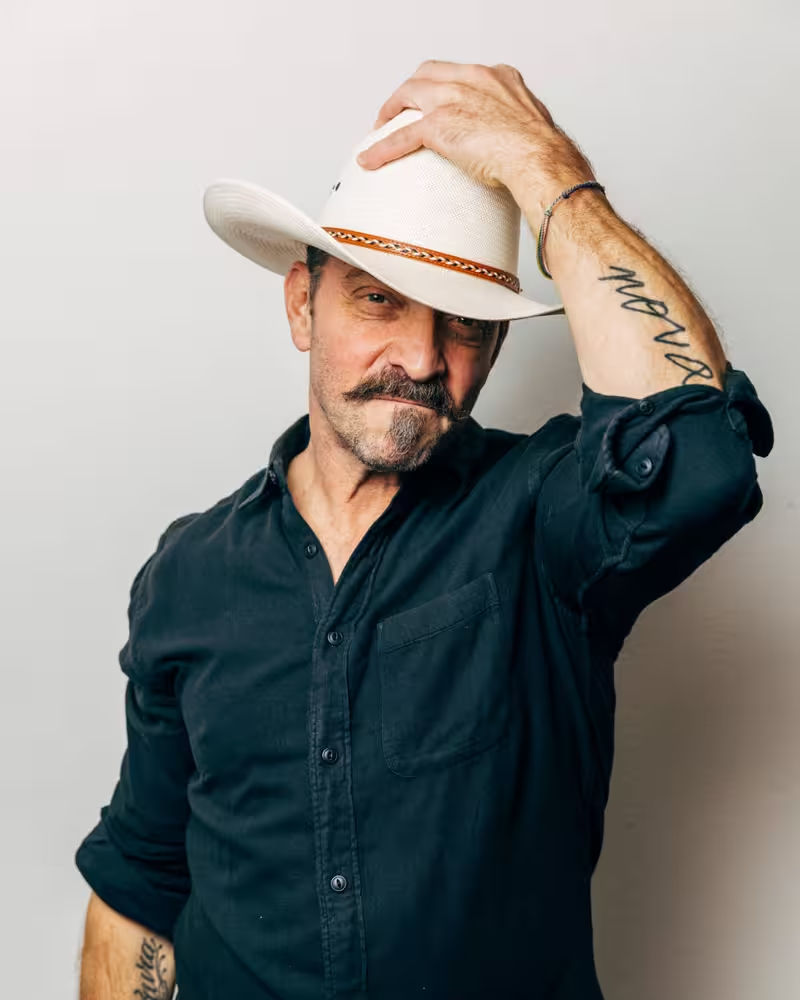
James Victore is a self-taught, independent artist and designer. Clients include Moet & Chandon, Aveda, Esquire and TIME Magazines, Yohji Yamamoto, Bobbi Brown cosmetics, The New York Times, and The School of Visual Arts. Awards include an Emmy for television animation, and Gold and Silver Medals from the New York Art Director’s Club.
Victore’s posters have been exhibited at the Museum of Modern Art in New York and are in the permanent collections of the Palais du Louvre, Paris, the Library of Congress, Washington, DC, the Design Museum in Zurich and the Stedelijk Museum, Amsterdam. Victore lectures and teaches regularly around the globe and he is a professor at the School of Visual Arts in New York City. His book “Victore or, Who Died and Made You Boss?” was released by Abrams in 2010. He lives, loves and works in Brooklyn, NY.
Talk: Create, create, create!
The primal call of life.
Transcription
[Applause]
I stopped in here yesterday when they were setting up and I walked into the building and it was kind of empty. And I walk in, and just took the lobby there, and I was just flushed with this warmth and this memory of this fucking kind and generous audience that I met 13 years ago. It’s so great. It’s so great to be back here.
And this is true: I make shitty slides.
And the reason is, because you guys are a fucking wealth. The amount of talent in this room, I cannot compete with. I’m not even gonna try. And the speakers too — there’s slides in their presentations, they’re so fucking fancy and nice. I can’t do that.
So I do this. And Marc called me and said — or did you text me? I forget. He called me and said, “Hey, 13 years, you wanna come back?” And then again, I was like, “13 years?” And I thought it was gonna be like this, it was gonna be like: “Yeah, doctor, it’s been 13 years since we saw each other. My life has changed a lot. I thought there were some things that we should talk about.”
So it is a treat and an honour and a joy to be here with me and my shitty slides.
So, I’m a good graphic designer. Pretty good graphic designer. I’m a much better teacher. I’m a much better teacher. I’m much more interested in the creative process, and interested in the people that make it. So bear with me while I take the role of a teacher here.
And one of the things that I do with all audiences is — I get this feeling that you guys are like, you’re sitting in these chairs, you’ve been here, you sat through Chip, that was tough. And…
What? Sorry, did I say something?
So I want everybody to stand up.
Listen, you’re an audience and I need your energy. I need your energy, you need your energy. So we’re gonna work out, we’re gonna get some energy going. So the first thing I want you to do is just shake it out. Shake it out, shake it out. You guys have been sitting all day, right? Shake it out.
Okay, there’s not a lot of room, but see if you can swing your arms. If you can’t swing, just kinda do — get your spine — ah, not enough, feel good. No, no, knocking over glasses, that’s awesome.
Okay, reach up super, super, super high. Wiggle, wiggle, wiggle. Oh my God, this is so beautiful.
[Audience laughs]
Is somebody getting this on — Marjan, Marjan, can you take my phone and get this? This is so beautiful, come on up. You guys are awesome. They’re playing along with me, Marjan. That’s so cool.
[Audience laughs]
Okay, arms up, right? Shake it out, shake it out. Okay, okay, now push-ups, everybody.
[Audience laughs]
Okay, okay, push-ups on your own later, okay? Okay, stay, keep standing.
Okay. What I do when I work with people — whether it’s this kind of situation or in my workshops that I do — is I get you to do hard stuff. That’s what my work is all about. My work is asking hard questions. I made an early career and I made a reputation and I made a body of work of asking my country difficult questions, right? It’s a relationship.
So I ask you guys to do something hard, and I need your help and I need your energy, okay? So I’m gonna start doing something and I’m gonna be super vulnerable and, oh my God, it’s embarrassing. Fuck that shit, right?
I wanna ask you guys to put your arms up. And start swaying back and forth. Oh my God, look how beautiful that is. Look at that.
So I’m gonna start doing something. You are gonna know what I’m doing, and I want you to jump in when you get it, okay?
[James begins singing “Purple Rain” and the audience joins in]
Oh my God, that was so good. So good.
Okay, you can sit down now.
Now, since class is in session — that was a test. Thank you, darling. That was a test.
It was a test of your ego, or lack thereof. It was a test of your creativity. Oh, you got people over here too. And it’s a test of your ability to just play.
So here’s the test. If you were like this — if you couldn’t stand up, if you couldn’t wave or sing — please ask yourself why. Ask yourself why. What is so blocked up my anus that I can’t have fun?
[Audience laughs]
Okay, please.
[Applause]
Boom. Boom chuck-a-lacka.
[Audience laughs]
Are you mocking me? Damn. I lost my clicker.
[Audience laughs]
I looked in the programme yesterday and it says I’m supposed to talk about “create, create, create.” I don’t know who did that. I don’t know who wrote that. But I will try to fit that bill.
Create, create, create.
That is the primal drive, the primal urge of every fucking bit of life on this planet. The grass outside — all it wants to do is create, create, create. All the squirrels and all the birds and all the animals, all they wanna do is create. All we wanna do is create, create, create. And that’s what drives us as a species.
Dude, you are so awesome, because you have got this frickin’ purple light that is just yours. It’s beautiful. I feel like you were, like, embodied Prince. Come back to check my work.
So Marc said, “Hey, come do the 13-year thing.” And I thought, oh, therapy, right, that’d be cool. But I said, “Yeah, but these days I don’t have slides. I’m not doing slides.” I’m like, if a stand-up comedian can do without slides, I can do without slides.
But then I was on the plane and I was thinking about it. You can see I do everything last minute. I was on the plane and I was thinking, you know, I actually haven’t seen my work for a long time. And I got this weird thing that, like, once I’m done with something, I’m kinda on to the next thing. So I kinda poo-poo my own work. I don’t know if you guys have that, right? And it’s not healthy.
So what I’m gonna do is I’m gonna talk about create, create, create, and how this urge, this drive, has driven my own process to get me wherever it is I am now, and the work that I’m doing now.
And assembling this thing, it was kinda cool, because I was like, oh, I make pretty good shit. I make good stuff.
So back in ’92, I made this. And I made it because — most of the work in here, I could frickin’ talk for a day on this poster alone. Like, the life that it’s taken since I made it, the influence that it’s had on designers and society, it’s crazy.
But I also kind of knew that I shot myself in the foot professionally when I made this. When I started on this path of being a social, cultural, political designer, right? I know that there’s a lot of — I’ve been very blessed that I’ve worked with amazing companies, and I’ve got two projects going with huge-ass companies right now, which is very cool. I haven’t even had clients in a long time.
But it’s funny, because when you choose a particular path, that means you have to un-choose other things. And I was never good at that. I was never very good at making choices.
My parents used to take us every Sunday and they’d take us to Baskin-Robbins, which is an ice cream place in the States. And it was like — there was, what, 52 flavours, I think it was. And I was just standing there like, “52?” And it was always like, “Okay, I’ll have black raspberry.” It was always — my parents, my sisters, everybody would laugh at me like, “You doing black raspberry, yeah, wah, wah, wah.” I’m like, yeah, fuck off.
So I made a lot of work. I made stuff that had meaning to me. And I can’t — like, again, I can’t talk to you about this, because it would take all day. Or this.
And the really disgusting thing is, these posters, these ideas — and that’s the thing, like, these are ideas. They’re not really posters. They’re not really beautiful, they’re not really pretty. They’re not designed to look good over your fucking couch.
But I like to use art and design as the teaspoon of sugar to talk about difficult things, to talk about bigger ideas. Like the death penalty. Like the Native American genocide. Like the racism we’re experiencing now.
And then I get wonderful opportunities to work for the School of Visual Arts and do bus shelter posters, right?
And these two, especially the beach family, were new for me. Because before, everything was, like, super minimal. That poster was — you know, it would be in the middle of the page — and now I’m, like, doing maximal. But like it says in the Tao Te Ching: trying to find simplicity in the complexity, and trying to find complexity in the simplicity, right?
You pointing at me? It’s not my computer.
[Audience laughs]
Guys, guys, that would be the fucking battery one.
[Laughter]
You can’t get it off to plug it in. Oh, okay, okay. I’ll go slow then.
[Audience laughs]
So you need to go fast.
[Laughter]
Thanks. Thanks.
And I like playing. That’s part of my create, create, create — is just to play. What do I do for a living? I make shit up for a living. And I play. I sit at a big table and I try to make myself laugh.
And then I get these wonderful compliments like, “James, I love your typo, your calligraphy.” This isn’t calligraphy. This is finger painting. This is finger painting, like — but blown up big, it looks kinda sexy, right?
[Audience laughs]
I get opportunities to work with very groovy clients. But see, when you create a reputation for yourself, when you’re known for doing kind of, like, not what people expect — most clients wanna expect something. And so it’s hard for me to work with them. But if you make a reputation for doing something interesting, you get interesting clients. Like, this was a Japanese condom company.
And then, and then, and then, when you do stuff like this and you play for a living and you get stuff and it becomes popular, you guys go crazy.
[Audience laughs]
Fuck. You guys go crazy. This happens all the time, it’s really weird. And the dude didn’t even ask me, he just, like, “Hey, check it out.”
[Audience laughs]
So I had to write him back and I said, “Just don’t tell your mom that I did that.”
[Audience laughs]
Are we cool? Okay, okay, thank you, doctor.
And you get to comment on changes in New York City. Again, I just wanna play. I just wanna play. I wanna make work that real people see.
[Audience laughs]
And then this happens. Stuff like this. They’re like, “Hey James, we think your work should be in the MoMA.”
I said, “I do too.”
[Audience laughs]
And so they — I said, “How does it work?” And they said, “Well, bring it by.” And I brought by a bunch of posters. I wasn’t gonna tell these stories, but I’m talking really fast. So this is gonna, like, take 10 minutes and then we’re gonna get out of here and have a beer.
So, brought a bunch of posters by. They chose 10 for their collection, which is awesome. And they wrote me and they said, “Hey James, we’re taking 10.” And they said, “Oh, and more, more — we are redesigning the third floor and we’re going to put up an exhibition, and we’d like to put up five of your posters on the wall.”
I said, “Oh, a small James Victore show at the MoMA. That would be lovely.” I said, “Is it — will there be a grand gala that I may attend?”
And they said, “No, we’re not doing that.”
I said, “Do I get a plaque?” Like, “James Victore, your work is in the—” Martin, did you get a plaque? You get— Okay, I didn’t either.
They said, “No, we don’t do that.”
I said, “Well, can I get a letter?” Like, with your gold MoMA — you guys gotta have a gold MoMA letterhead, right? You guys got your fucking MoMA. I said, “Can I get a letter?”
And they said, “No, we don’t do that.”
So I said, “Well, can you do it anyway, for my mom?” Because she would really dig that.
And I shit you not, a week and a half later, in the mail I get — I open it up and it says, “Dear James Victore’s mom…”
[Audience laughs]
Ask for what you want. Ask for what you want. The universe will provide. The dude abides.
[Audience laughs]
Okay. So I was a designer for a long time. I was doing commercial work. While I was doing these posters, I was doing a lot of commercial work, which was okay, it was good stuff. I was making the dollar, right? But at the same time I had these ideas.
And I came up with what I called the 11 Commandments, and I printed them on stickers. And then what I was doing for clients was, I would go and visit and do a talk at their shop and install this basically fancy bathroom toilet paper roll and put the 11 Commandments on, so their people and guests could take a sticker.
Don’t count — there are 12 here. Don’t count. But 11 sounds better than 10.
So — but this started a lot for me. This started a lot of ideas. There are stickers that say: “You become who you pretend to be.” This is all from philosophy. “Teach your tongue to say ’I don’t know’ and you shall progress.” “Advertisers think you’re stupid.” It’s funny because it’s true.
So it was these ideas that I started playing with, and I enjoyed that, and I wanted to start incorporating it into my work. And that’s what I do now. And if I can’t find a client to produce this stuff, I produce it on my own.
So I got the opportunity — I’m in Texas now. And before this I was in New York for most of my life as a designer, and I had the opportunity to work on a big, huge project for the New York City Department of Probation. Like, the last client that you think I can do great work for. And I did great work for that. It moved me.
I worked with the boss. He was a new boss, so of course that’s the only way you can get good work done, right? And they were very cool. There were some little battles, but they were very cool.
They let this series of posters— I like series. There’s like “Bugs and Bunnies,” right? Two posters. There’s like “Just Say No” and “Disney Go Home.” I like series, it works better like that.
So I did a series of posters for them based on those crappy motivational posters. It’s like an eagle and it says “Vision.” Because, like, eagles have good eyesight, right?
So this was a lesson in perspective. And the lesson in perspective is — which is hard to read here — the lesson in perspective is always a little text that we wrote. And it says: “You have no friends, you have no enemies. You only have teachers.”
If you can understand that, the world opens up for you. If you can understand that, you can understand that your worst enemy is actually trying to be a teacher and show you something about yourself.
So: lesson in perspective. Improve yourself, change the world, start here. Start small.
So there were 33 offices of the DOP, and these were just one-offs, just big stickers, basically just big stickers. And they got hung in all of the offices.
It was wild. Like I said, I could talk for a day on this project alone. It was so cool. And all the influence it had on the probationers and on me.
So the first thing I thought about when I was working on this series was like, “Oh, I’m gonna do motivational posters.” And I’m like, “Like the ’hang in there’ kitty” — that hung in my sister’s bedroom when I was a kid. And I always thought, “That’s funny. Cat’s hanging in there, get it?”
But to tell probationers to “hang in there” is not the right message. “Yeah, just keep doing what you’re doing. We’ll see you in a week.”
But we wrote this text on it that says: “Let go. Let go of everything that you’re attached to. Let go of your preconceived notions of how it’s supposed to be and what it’s gonna be like. Like, let go.”
Because to teach somebody to surrender is super important. If you’ve ever taken a fight class or a yoga class, you know that you’re in a difficult situation and you’re like, “Fight it.” Take a breath, relax, surrender — and you will find your exit, right?
“Ask for help.” Again, the geese. Teamwork. No, fuck that. Ask for help. Ask for help.
It’s a hilarious story about all the little doodles on it. My assistant at the time didn’t erase those before the presentation. So we’re in the presentation with the DOP, you know, these suits, New York City suits — cops, basically. And I look and I see the little sun and the moon and — his name is Chris — and I’m like, “Chris, Chris…” And he goes, “It’s okay, it’s okay, it’s okay.”
And it was. It was okay. It was like they didn’t — all they cared about was the teeny little words, like, to make sure I didn’t say something dumb or swear or something. It was awesome, it was awesome. And they didn’t even have a logo, so I gave them a logo. I threw that in for free. So…
This, I was just looking at. Again, I haven’t seen my work in a long time. So I was just looking at that and I’m like, “Oh, bleh, I made a mistake.”
Because I don’t say — if you asked me, if you’re, like, coaching with me, and I’m like, “Well, you know, there ain’t no shortcuts.” I would say “there ain’t no shortcuts.” I wouldn’t say “there are no shortcuts.” I should have put “there ain’t no shortcuts,” because that’s funnier — because it’s a shortcut, get it?
[Audience laughs]
“Ain’t” is a shortcut.
Oh, by the way—
[Audience cheers]
Don’t know how that got in there.
But since we’re on the subject: trans lives matter. Black lives matter, right?
[Audience cheers]
Women’s rights matter. Why are we arguing this?
[Audience cheers]
And along with that, men are proving themselves to be massive assholes. And men have been in charge of this thing for way too long and done a shitty job. So I think it’s time we elect some women into this position.
Also — wait, there was one other thing. Trans lives matter, Black lives matter. Oh — DEI matters.
Because I was taking my kids out for a walk and we go out in the woods. And there was just this point — it was early in the morning and it was wet and it was so beautiful. And there was, like, all this different life and flowers coming up and all these different trees.
I was like, “Guys, how many trees are there?” And they were like, “Ugh.” I was like, “How many kinds of trees are there?” They were like, “Ugh, yeah, it’s lots.”
That’s what life is. That’s what create, create, create is. Because if it was one type of grass and one type of tree, they would all die. One disease comes and you’re all fucked.
And that’s what we can’t have as a species, as people. So we need to kind of start accepting ourselves and accepting other people. Because that’s fucked up, man. And that guy is fucked up.
[Applause]
I had a lot more political slides in there that I took off. So, yeah, they were kind of nasty.
I don’t work with clients, I work with comrades. I can’t do good work unless a client trusts me. So I’ve been working with the Do Book Co for over 10 years and done, I think, 50 or more covers together.
And we have a deal. We have a deal, because their budget is not what I usually got as a designer. So I said, “Okay, here’s the deal. For that much money, I will do the series look, I will do all of your covers. But you get no say whatsoever.”
And they said, “That makes us nervous.”
And when the first three books came out, they said on their blog, they said, “James Victore asked us to trust him, and we’re glad we did.”
And now this thing has gone out to 50 or more books. Every time I see it, it’s a couple of different books at, like, the Tate or the MoMA bookstore, or their museum quality. And I’m like, I love this client so much.
And the reason I don’t want to work with many clients is because I know what I’m capable of. I’m capable of this. You wanna change the world? Ask Jim Bob, right?
Most clients are capable of this — out of fear. Chip mentioned clients. As soon as he said, “We took it to the publisher,” and then they went into the meeting room — I forget what it’s called — where all the editors, all the editors basically stand around and throw rocks at your work. Yeah, that scared the shit out of me.
So I quickly took photos before I left. I was like, “Oh, I really like those.” They’re so simple and they’re so lovely. And the objective here is to do the cliché without doing the cliché. Like, how do we do that?
Okay, I’m going too slow here. I gotta get going.
The author here — Do Preserve — got in touch with me and said, “That looks like the perfect elderberry jam.” And I said, “It’s finger paint. It’s purple. Purple.”
Do Design. Alan Moore hated this cover. Guess what? I don’t care.
[Audience laughs]
You know, and it’s not because I’m a dick. It’s not because I’m a diva. It’s because I wanna set boundaries. Because I wanna be happy. Because I don’t wanna be on the losing end of compromise all the time. And that’s what we find ourselves at. That’s the place we find ourselves at.
Why do I have to keep any — that’s like a — anyway, not English.
So there’s one idea that I love that I’ve been holding onto forever, which is this one, which is: the things that made you weird as a kid make you great today. If you pay attention to them, right?
Most star athletes or chefs or comedians, when you ask them about their origin story — it’s like, “Oh yeah, me and my dad out in the backyard until it was too dark to see, and your mom called us.” We would just sit out there playing, right?
I have a friend, his name is Gary Danko. He’s a chef. His restaurant is in San Francisco. It’s called Gary Danko and you can’t get in. And I worked with him when I was, like, 18. I worked in his kitchen for a little while. Amazing guy. Huge monster of a guy, very flamingly gay. I was, like, small-town, small-town upstate New York. He showed me the world, man. He taught me fucking — he’s amazing. Amazing guy.
But he tells this story of when he was a kid. You know, that’s the best start for a story ever: “When I was a kid.” It’s better than “A long time ago in a galaxy far, far away.” It’s up there with “Once upon a time,” right? When I was a kid.
And the way it goes, his story is like — he says, “When I was a kid,” he says, “I was about eight or nine,” and he says, “My mom woke up in the middle of the night, because there’s all this pots and pails and noise in the kitchen.” And she goes down and he is naked, except he’s got her apron on. And he’s pulling out all the pots and pans.
And she says, “Gary, what are you doing?”
He says, “I’m gonna bake a cake, Mama.”
And he said, “At that moment, my mother knew two things about me.”
[Audience laughs]
Pay attention. Pay attention.
So you know what made me weird as a kid? I’ll tell you this story quick.
When I was a kid, I was— the military. I wasn’t in the military when I was a kid. We were in a military family, but we were stationed in New Mexico. And my first visual memory — and I’ve had it my whole life — my first visual memory, colourful, was of a pool of melted crayons on a hot cement porch.
Imagine that. This mélange of colour.
And about three years ago, I was like, “I better check. Did I just fabricate that because it’s, like, a cool story for a designer to tell?” So I asked my mom. And I called my mom and I said, “Hey mom, do you remember melted crayons on a hot porch?”
And she was like, “Oh yes. I remember.”
And I could tell from her response that — one, I remembered this colourful, exquisite art. But her memory, when I was a kid, was infused in that. So I also remembered that visceral response. That kind of anger. Pissed off.
And to this day, all of my work seeks that. I want it to be beautiful. I want it to be sexy. I want it to confuse people. I want it for you to love it or hate it. Because I’m not gonna stand in the middle. I hate that.
So it’s so funny that with that beauty and that mixture of colour — excuse me, color — is one memory. And every time I design a book cover, especially for myself, there it is. I didn’t even know it. There it is. There’s that me trying to recreate that thing that I saw when I was a kid.
And it was a page, and I wrote about it in Feck Perfuction.
These are my weird kids. Wyatt and Nova. Boom.
These are my mentors. These are my teachers. And they teach me. So I’m a single dad with two kids.
They are barnacles. They love me, but they’re barnacles. They’re, like, stuck on me, right? So I’ll be doing dishes or I’ll be doing something and they’re like, “Dad, dad, dad, dad, dad, dad, dad.”
And I can’t do what was done to me. I can’t do what was done to me. And what was probably done to you, right? I was shut down. I was not allowed that. I could not go, “Hey, dad, dad, dad.” I couldn’t do that. My parents were not interested.
So if I can’t break away immediately, I say, “Guys, give me a second.” And then I finish and I go and I go, “What are you doing? Tell me. Show me. Tell me what you’re doing. I wanna know. What was the thing you were telling me?”
Because what they do, what they’re showing me, what they’re presenting to me, is that primal drive of create, create, create. And it’s personified in what they ask me for. And it’s what none of us can fucking remember to do. And we’ve become shitty at it as we’ve grown up. Partially, because it probably wasn’t allowed when we were kids.
And I hear it constantly in stereo from these guys. And it’s so powerful. And you guys have got to learn how to say it. And it goes like this:
“Hey Dad, look at me. Look what I can do.”
We gotta learn how to do that again. Ask for what you want. People to say: look at me, look what I can do.
Marjan was showing her work — the Sunne, where you touch it and it reads you — and it’s, oh my God, it made me cry. That’s awesome. Look what I can do.
So now I’m working on a series of posters inspired by my kids. They’re actually for my kids. Because I showed you the “let go” kitty in my kids’ room. My daughter’s hidden there with all the stuffed animals, kind of like E.T. style.
So now I’m making a set of posters for them, because I’m like — what a, what a, what a — there’s an audience that isn’t being paid attention to. I wanna talk up to that audience. I see the stuff that’s available for kids and it’s shit.
So I’m working on a series of posters. There’s four, six, I don’t know yet. But they’re smart and they’re intelligent ideas. And I took my kids to coffee last Sunday, we were together, and I showed it to them without, like, prefacing anything. And that was like, okay, it was like a test. Like, “Oh, okay, what does this one say?” And they’re like, “Oh, that means we should trust ourselves.” I’m like, fuck me, that’s awesome.
So I don’t know how to — I’m trying to get these out the door. If somebody wants to sponsor me and make some beautiful silkscreen prints, let me know. By the way, all of the work is available as originals or as prints, so let me know, drop me a line. Or maybe I go to — what is it, what was it — Kickstarter or something. I’m not sure. But these are gonna see the light of day pretty soon.
I just like painting on everything. Even ceramic. I love ceramic plates. These are, like, 20-pound platters. There were, like, 30 of these and now they’re all gone. They all sold, which is cool. Or they’re in a friend’s house. Debbie Millman has one of these in her house.
The Hangman poster came back, right? Solve it. Let me hear.
“Fine.” “Free.” “Feel.” Excellent, excellent, excellent. “Flatulate.” Doesn’t even matter. Why — we’re creative. Why do we have to limit ourselves to four letters, right? Awesome.
But teeny-weenie in the bottom it says: “This is a test.” Because it is a test. Because if the first thing — if all you can come up with is, like, bam, bam.
So, these are two new prints, or silkscreens. And the cool thing about “Love Always Wins” is the little piece of paper that was literally cut out. I found it in a drawer and I’m like, “Oh, that’s cool.” And I photographed it, and I couldn’t figure out how to get the shadow to print well or look really awesome in the silkscreen. So it really looks, in the life — it’s like Day-Glo orange with this shadow to it. The shadow is all drawn in by hand with pencil. It’s so nice.
Now I spend time with you guys. Doing workshops and getting people excited about what they do for a living. Excited about their own gifts. Excited about looking inside and saying, “You know, this is what I’m capable of.”
I tell this joke that’s based on Emerson — Ralph Waldo Emerson. And Emerson said that most men lead lives of quiet desperation. And I say: we lead lives of quiet desperation because we know what we’re capable of. But we took a job instead, right?
So good. And I love what I do.
And I don’t wanna say “fuck AI.” It’s part of the game now, and it’s weird. It’s weird. And I got into it for a while in the beginning, for the last couple of months, because I was trying to learn it. I was like, “I better start accepting this thing.”
But I got lost in it. And what happened is, I started accepting its answers. And then I would spend a week trying to sift through its answer to try to make it sound like me, or make it make sense. And what happened is my brain started going to mush.
Because we’re starting to not trust ourselves because of this thing. We’ve gotta figure that out. We’ve gotta figure out how to maintain our own independence. How to trust our gut. Trust ourselves. Trust our audience. And not AI.
Because it’s just gonna get pulled out—
[Applause]
It’s gonna get pulled out from underneath us, or we’re gonna have to pay for it pretty soon. It’s just a temporary thing.
So I’m trying to start the next version, which is community. Which is craft and skill and pride of our making. The next future is handmade crafts given to each other. That’s important.
And there was an ad floating up there from earlier. This is a webinar that I’m doing in a couple of weeks called “AI and You.” Go to jamesvictore.com and you can read about it. I wanna be involved in this. I wanna shepherd us through that. I know how frustrating it can be. I know how frustrating it can be.
So the future is going to be community. But the future more than that — more than that — and the future more than that is going to be us understanding what we’re capable of.
Because the future is that your work is a gift.
And when you understand that your work is a gift, it changes how you think about your work. It changes who you work for. It changes what you do. You might start to create boundaries around it.
It changes how you think about your work. Your work is no longer about winning a paycheck or making a boss or client happy. Fuck that shit, right?
And I know we wanna keep our jobs. But I also know that we’re stronger than that, and we’re smarter than that. We can figure this shit out. Why? Because we’re creative. It’s a creative answer.
So when you understand that your work is a gift, your work becomes stronger and the gift becomes stronger. Because now you give something of yourself, right?
You guys are awesome. I love you. I’m outta here. Bye.
[Applause]