Kimya Gandhi
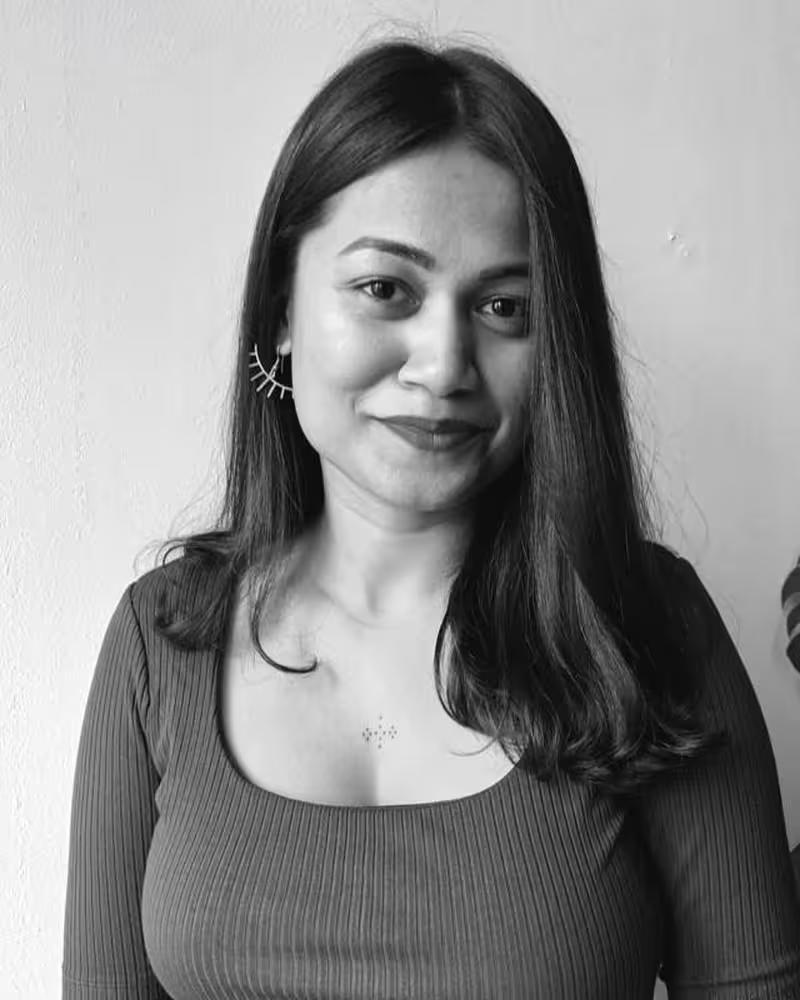
Kimya Gandhi is a type designer from Mumbai with a passionate interest in Indic type design. Kimya holds a Bachelors degree in Communication Design from National Institute of Fashion Technology, Bombay. She further went on to pursue specialisation in the form of M.Des in Visual Communication at the Industrial Design Centre, IIT Bombay. She got her professional start interning at Linotype in 2010. Over the next few years she freelanced for several type foundries catering to their multi-script requirements. In 2015 she became a partner at Mota Italic and now focuses on Indic and Latin designs for retail and custom corporate projects.
When not drawing typefaces, Kimya regularly teaches type design and typography at several design institutes.
Talk: The Act of Pressing a Key: The Journey of a Letterform on to Your Screen
We live in a world where we encounter letterforms every day. We type on our phones, read books, glance at advertisements on the train, follow signage to reach our destinations. Letterforms don’t just carry information – they are a means of expression, shaped by history, culture, and context.
These forms have evolved over centuries, across regions and writing systems. One such script is Devanagari, used to write languages like Hindi, Marathi, Nepali, and Sanskrit, and read by hundreds of millions of people.
Join Kimya on the journey of a letterform – from its conception as a drawn shape to its behaviour as digital text on your screen. Drawing from my own experience designing Devanagari typefaces, she’ll reflect on what it means to work with a script that carries cultural memory while constantly being reshaped by new tools and contexts. What does it mean to design for a script you grew up with? And how can type design become a way of re-seeing and re-claiming what feels familiar?
Transcription
(Applause)
Thank you.
(Applause)
Hello, everyone.(...) Thank you. When I meant that I didn’t mean that André is less of a nerd, I just was a little nervous following up with a guitar performance, I mean.
(Laughter)
All right, so, hello, everyone. My name is Kimmy A. I design type faces.
This is how my name looks in the script that I design in. It’s called Devanagari.(...) Devanagari is a phonetics alphabet, which means that you read what you see, and there’s no silent sounds or inconsistent pronunciation, and it’s really cool like that. So if you haven’t seen the script or anything, you’ll see a lot more in the next few minutes.
So this is my name, and how you pronounce it is like Kimmy A.(...) Gandhi. So it’s when you start, that’s what I meant by it’s a phonetic script.
I draw tie faces for retail libraries and custom client projects,(...) for brands, lettering for movie titles, and sometimes music albums.
Together with my partner Rob Keller, who’s here,
we run the type foundry called Moto Italic.
We are not just partners in work, we’re also partners in life, and a couple,(...) actually I was going to say a couple years ago, no. Several years ago, we got married in Mumbai,
and we now live with our two cats.
(Laughter)
And now we work from our studio space in Berlin,
and it’s really cool to be living there. I’ll start by telling you a little bit about me,(...) and so that would set the context of the work that I do, and a little bit more about the script, like I said. So I finished school in 2002, and type design as a profession seemed like the stuff out of a completely different galaxy. I had no idea about this field, or that there’s this whole new world of letter forms waiting for me.(...) I started my Bachelor of Studies in 2004, though, still undecided what I wanted to do.
But growing up in India in the 90s, my parents were very wishful that I would study medicine.
And a couple of years ago, I found this proof that I,
as a good Indian child, did give the medical entrance exam to please my parents.
But unfortunately, my interest in biology was so far, I went to only drawing medical diagrams. So even though I gave the exam, I figured this is not something I wanted to do.
So in some strange wind diagram of age and stupidity, I gathered the courage to kind of tell my parents that this is not what I wanted to do, and I really wanted to pursue design. So I went to design school, and I did my Bachelors and Masters in Visual Communication. But both my projects there were typeface design projects. I did study Visual Communication because there isn’t a specialised typeface program still in India, which is kind of strange. You’ll see that there’s such a variety of scripts and languages, but such a program does not exist and still does not exist, actually. And it was quite expensive to go to Europe to do a full Masters program, also because there were not really type foundries. So I didn’t know if I wanted to go study and come back and do what. But interestingly enough, I did my internship not so far away from here in a lovely town called Bad Homburg, and that was actually my entry into type design, and it’s kind of cool that several years later I’m back here to speak about my journey.
But now I’m again, like I said, I work in Berlin,(...) and this is surrounded by a lot of more letter forms, and I’ve been mostly independently working with a lot of other foundries, but also working on our projects for ourselves.
I don’t know how many of you have been to India,
but I just wanted to, before I showcase more of my work, I just wanted to give you a little bit of an overview of the typographic landscape of the country. So India has 28 states, and each state has its own script, own language, so it’s really the variety of not just languages and scripts, but everything, lifestyle changes every few kilometres that you travel.
They are all linguistic states. There are 12 different scripts and 22 languages, but there are also a lot more dialects and languages, and some of them which gradually have also disappeared.(...) Just to give you a little quick look, like these are what the scripts look like.(...) As you can see, they’re all very different from each other, and it’s very interesting that if I would go to another state, of which I don’t read the script, I would be as new and touristy as any of you would be.
So these are the names of them,
but we focus mostly on Devanagari, which is the script that I work in, and a little bit more information about how the script works. So as compared to Devanagari is the script actually that is used to write the language Hindi, so you’ve probably heard about Hindi more than Devanagari.
And my work straddles basically working in both these scripts, but I mainly focus on the Devanagari part.
Some key differences between both the scripts is that Latin sits on a baseline, whereas Devanagari hangs from a top line.(...) It’s a unique script, which means that there is no upper or lower case, everything is in the same. But the calligraphic angle for Devanagari is exactly opposite of that of Latin, so if you’ve done any Latin calligraphy, you know that the 45 degree angle gets exactly reversed.
The vertical metrics for both the scripts are quite different.
As you have, you probably for extended Latin, you have a lot of diacritic marks and things, but for Devanagari you can see that the vertical metrics can quite expand because of these marks that can be placed on top of the top line or under the baseline. So it’s quite a more complex system of writing.
Anyway, so now that you’ve had a little bit of an overview of the script and what are the differences,
I think you’re ready to maybe dive deeper into this.
Often while designing fonts, I think back home at least, people just think that fonts just exist and they show up on our computers magically.
So I thought I would like to take you on a journey of seeing about what happens when we press a key and how this letter form appears on our screen. But if you are expecting a technical explanation of what lies under the keyboard and some mechanics of the key, that’s not what I’m going to do. This is rather a longer philosophical route into the world of Devanagari letter forms.
So the word for letter form in Sanskrit is akshar, which literally translates to that which cannot be destroyed. So the idea is that even though shapes and tools and mediums change over centuries, the intrinsic idea of the letter form still remains the same.
So let’s dive deeper and see what happens when we press this key. What I’m going to try to do is take you through the journey of typing this word, the word that we saw, akshar, together. So we start with the first character.
That’s the vowel sound and that’s what it looks like.(...) But this is not how the letter form has looked always. Devanagari has evolved from an ancient script passing through many stages of evolution before kind of stabilizing itself around the 11th or 12th century.
Brahmi is one of the oldest writing systems of the Indian subcontinent and it’s serving as the ancestral source of most of South and Southeast Asian languages. This is what it looks like. Some of the earliest inscriptions are found on stone.
And this is the script that gradually diversifies into all those regional scripts that I showed you earlier from different states.(...) So basically the letter form has gone through all these changes and that’s how, you know, before what it looks like today is what you see.
But even the relatively modern form of this letter form has seen many variations in early manuscript styles. So there have been really beautiful examples of a lot of these manuscripts. So it’s a little bit of a side journey into also looking at the evolution of the script.
There’s still a long ways before we’ll reach the screen, but the history of printing in India is also important to understand the social context of the letter forms because the printing press reached India via the Portuguese colonial authorities in the 1500s. And this was basically how printed text reached India. The first ever metal type of Devanagari was actually cast in Rome.
And a lot of these early printing presses were set up by missionaries for printing religious texts and translations into local languages. So this kind of it’s interesting to understand why these scripts were even mechanised in the first place. But I’m going to take some big jumps because I guess if I start talking about the history of the script, we’ll be here for a lot longer.
So it’s also you probably have heard of the linotype machines. And so soon with all these printing developments were also reaching India. And but it’s interesting to me to see that this the reception of these machines is quite different and decorated.
But what this did actually was the machines and the keyboards were based on the Latin script, which has relatively fewer characters. So the Nagri font would have several hundred glyphs that now needed to be crunched onto this and fit onto this keyboard that was built for Latin based scripts. So this kind of posed a large problem of how the script would be rendered correctly.
Ironically,
instead of improving keyboard layouts or hardware,(...) there were in fact some script reform ideas of saying, let’s change the way the scripts look so that we can adapt it to the keyboard, which to me sounds really strange.
There’s also while we’re making several big jumps and eventually after several photo types setting, blah, blah, blah, all of these different technologies, we finally arrived to the digital age of computers. And this posed even a bigger problem because even with the keyboard computer, it was hard for the Nagri and other index scripts to be input. So a lot of companies started making software that would enable you to input the script. So kind of the focus shifted from the letter forms and the typefaces to this kind of software. And because the companies wanted to keep their clients close, these proprietary software companies started making their own encoding and not using Unicode, which means that if you switched your software company, you would not think that you would have to do that. So you would not start reading anymore. So this a lot of publishing houses,(...) some of them actually still use some of these non standardised fonts because they’re, you know, operators and everybody are already set with this. But again, several decades later, I think with more internet and the need for information to be put on online made it more necessary to have more Unicode standardised fonts.(...) And present day libraries look a lot more like ours, look very similar to anywhere in the world currently.(...) So there are also several marketplaces and independent foundries that are in India and working on Indian typefaces.
With more internet usage, I think it has changed drastically the way we read in India today.
Nearly a billion people are making our online making it one of the largest internet populations in the world. There’s a lot of people.
And even though English is heavily used in operating systems and even, you know, billboards and other things,
primarily a lot of, you know, some news or music lyrics or family WhatsApp groups are very commonly using Indian scripts to message.
It’s also I think India is a very interesting demographic that there’s a lot of cultural traditions that live on along with a lot of technological advancements. And this is just to give you an example of video I took of an aunt who is kind of using it. You can think of this as like a rosary thing where you’re kind of trying to pray. And this is what they need to I don’t know. She has to write it. But instead of that, somebody made this app and all that she has to do is just type. And that’s apparently the way of praying now.
But the visual landscape in India is quite diverse.
The typographic landscape can shift heavily from traveling from smaller towns to bigger cities. So you would see a lot more Indian scripts on billboards and signage is in smaller town as compared to bigger cities like Mumbai. But it still exists. It’s not that it’s completely devoid of it. It’s very common to still see a lot of hand painted and modular forms of the script. And these are some of the most beautiful examples of how vibrant the forms of the script are and form a really huge inspiration for my work.
But India is also a place for contrast. And recently there have been metro constructions in Mumbai. And again, so these are where all the construction sites are. They are plastered with these hand painted things called Mumbai’s upgrading. So it’s kind of instead of printed banners, it’s just the city is filled with these hand painted versions of metro line.
India is also a very multilingual country. So it will many times you will find four or more sometimes at least three scripts on any road signage, which can also again be hand painted at times.(...) At the same time, there are small copy shops which have now opened in every neighborhood, making it really accessible to design, print and has democratised the access to fonts.(...) So easy that you can actually print a banner wishing somebody happy birthday on your street.
Traveling in India makes you also encounter letter forms in several ways.
The railway signs, if you think look familiar from train stations is because they do. They’re still part of our post colonial hangover.
Unfortunately, a lot of the highways and train stations and even the new metro lines don’t follow standardised typographic systems.
Sometimes this is a gate sign from the Mumbai airport where you see the like two sides of the same sign, but one renders the script correctly and one doesn’t. And I wonder what happened there.
But again, the design problems in India are quite contextual. And I guess if you’re one of these people waiting to get on that train,
looking at the font on the train is the last thing on your mind.
It’s yeah, but also these large number of users give insights into behavioral patterns. Platforms like Google fonts with open source options show extremely large numbers of people using these.(...) For example, this one particular font called Baloo, which is described as a soft, affable design. But it gets used on a story that says 100 seconds of crime.
So clearly the question is, are these qualitative decisions or is it a matter of convenience?
The rules that make it mandatory sometimes to have a local script alongside a store sign is a great potential, but often missed opportunity because, as you can see, they are not belonging to the same world. Sadly, I had my own tryst with this problem when I got to design the Devanagari logo for Ramova.(...) And I was really excited that there’s a store in Bombay and I went to see it. And sadly, they don’t even use it. So I had to then speak to people and hopefully someday.
But yeah, that’s how it makes me feel.
I guess in most cases, the state of typography is stuck between a rather large scale of being indifferent to some misplaced nationalistic pride. And that’s something that’s kind of the context of design that I’m working with. The representation of India and type worldwide is also quite limited. I’m sure you’ve been to some restaurant that has this typeface across the front and had some questionable Indian food.
But this is a highly appropriated design and does not do justice to the vibrant plural scripts from the country.
So yeah, with that, let’s get back to typing that letter again.
Having understood a bit of the context and history of the script.(...) So we made our journey through time and places to understand the context and existence of this "ur". But we type forward and write the sound "ksha" from the Akshar. We need a "k" sound and a "sh" sound, which kind of makes this-- Devanagari has these fascinating things called conjunct characters, which are basically combinations of two or more consonants. So that’s how the word would look like when you simply type it. So it’s "ur" "ksha", but it’s not still making this conjunct character. And to do this, one needs to have substitution features. So while designing Devanagari typefaces, it’s not just OK to just draw the shapes, but it also involves doing some-- I feel stupid saying something about coding after all that I’ve seen in the two days, but it’s really simple substitution features. But without that, you really can’t even read the script, so it is important. So voila, we have the "ksha" here. So you can see the back end of the font software here, where you can see all these features. And it’s not just for these conjuncts, but several other features need to have a back-end open-type layout for the script to work properly. It’s not just sufficient to have these open-type features programmed in the font. It’s also important to switch it on in the world-ready composer in any Adobe software, because otherwise-- I mean, you might have the open-type features, but if you don’t have this on, the script will still not render.
And if you don’t, this can kind of lead to very catastrophic mistakes. This I found recently in Illinois, which is apparently a language assistance form which does not render the script correctly at all. So I don’t know what language assistance this promises.
And more importantly, if you ever plan to put any Devanagari letters on your body, please, please consult a local speaker first.
Yeah, but there we go. We then have our "ur" and "ksher" and then "ruh," which makes the word "akshar."
The good news now currently is that new software and new font softwares make it relatively easy to design Devanagari typefaces and any other Indian scripts and do this programming and have the focus back on the design. So it’s possible to have variable fonts and multiplexing families to display fonts with some fun to, again, variable families that can do really different widths or even color fonts. So it’s really a time, exciting time to be a type designer and experiment in play. And this is primarily the area in which I like to work, is try to innovate new ways of bringing these technology to Devanagari typefaces because I should let them have all the fun.
So I quickly share a couple of my projects to just explain how I incorporate this idea of play in some of my work. So this is a fit Devanagari, which is actually an extension of the Latin fit typeface, if you know, designed by David Jonathan Ross, whose many other typefaces you’ve been seeing on the branding of the conference.
This is also... So when I mentioned Devanagari has a lot, many more characters, you can see that the font software, this is my window, and there’s a lot. Those conchon character that we created, there’s several hundred of them, and the character set can easily be up to 800 glyphs. But then,
at least it’s possible to make... So fit is also a cool design where it kind of fits any paragraph that you set it in. So here is...(...) Sorry.
Oh,
delay, sorry.
Okay, so here you can basically type... As you keep typing the width of the characters, you can see that the styles keeps getting narrower and narrower, so you can say beyond tellerrand is...
Fun.
Really fun.
So I think fit was for me not an exercise in legibility, and it was not about like why, but why not. And I think if you... Because you saw some of these historical representations of the script, I think it’s kind of usually seen as this more traditional, but I feel like Devanagari can also look very cool and fun and vibrant, and that’s exactly what I did, and I had a lot of fun designing this particular typeface. And since its release, it’s been really fun to see a lot of people using these for branding, for movie posters, for YouTube channels, and more branding products, and even a design conference. So I think that’s pretty cool.
Also,
a little part of this project was featured on V-Transfer,(...) and that was kind of the most rewarding parts because a lot of my friends and family who have no idea what I do just had this pop-up of my work coming in, and they were like, "Oh, I guess you’re doing something cool after all."
So, yeah, and then later this project also got exhibited at a space in London, and I felt like this is exactly what I wish for Devanagari letters to be big, bold, and celebrated. So it was pretty cool.
Another project where I tried to use a lot of open-type features was this kind of more handwritten-inspired typeface, and you may know, and you probably used a lot of Latin typefaces that have several alternates of the same character, but this wasn’t ever done for Devanagari, so it was kind of the first of its kind to have different alternates for the same consonant, so there’s a lot of alternates for each consonant. Then I decided, inspired from a lot of these hand-painted signs, added some swash characters, and it was a lot of fun just keep on adding more and more, but then I realised that I drew a lot, and this particular typeface now has 3,500 glyphs.
But typefaces are as much as our mediums for conveying information, also our cultural artifacts.
It’s very common to see a lot of these icons and emojis that we use, along with letter forms as well, and I decided why not add some Indian-inspired icons to the mix, and so with this handwritten font, I added a bunch of iconographs from several festivals and things so they can kind of work together with the typefaces to make better visuals.(...) In another typeface, these kind of glyphs that form the building blocks of patterns, when you combine them, can make several different patterns, which are actually inspired from a local embroidery textile design, and then you can make a lot of fun patterns with them.
And lastly, a large part of my work involves sitting in front of the screen. I had to really work hard to bring you colorful images of what I do, but in reality, I just push black and white pixels all day.
So it’s sometimes fun to make things that make these letter forms jump off the screen.
I love cooking, and one of my typefaces I decided to use for these spice jar labels, and so it’s kind of cool to actually print them and use them.
I love cooking Indian food, but also I love making fresh pasta, and so this is my homage to the lovely Pomodoro. That’s what it says.
And another recent project that I really was glad to work on was a watch. I designed these watch face numerals for Devanagari,
and it was really amazing to see a physical product. I’m wearing it. If you want to come see it later, you can see.
And so finally, maybe you’re wondering why you sat and looked at all these letter forms you could not even read.
But I do believe that representation matters.(...) To me, it is about sharing my experiences and sharing the vibrancy of the script to different people from different parts of the world. And maybe this inspired you to make a trip to India.
And although I’m happy being here and have this opportunity to meet you,(...) public speaking is not really my favorite thing. I’d rather sit in front of the computer and move those pixels.
But I think it’s important to share this with everyone. And it’s been my effort to showcase Devanagari letter forms to a global audience whenever I get the chance. So be it for lettering projects or magazine design, it’s really great.
And it was a really sweet coincidence when some of my work was exhibited at the Offenbach Museum a couple years ago, a place where I visited when I first came to Germany as an intern. So it was kind of like a really nice full circle moment for me, and I felt really happy.
And I think I will take my responsibility of what I create very seriously, but I try to enjoy it as much as I can. So I showed you a lot more of my fun projects. I do design boring typefaces as well. But I think my attempt is to try and create more and more tools for graphic designers in India to create a new visual landscape.
And yeah, so I guess it started with just pressing one key, but there is behind it is a lot of history, technology and series of decisions that I hope you enjoyed.
And this year actually marks also my 15 years since I started drawing letter forms. So congratulations to beyond tellerrand and congratulations to me.
Thank you very much.
(Applause)