Marjan van Aubel
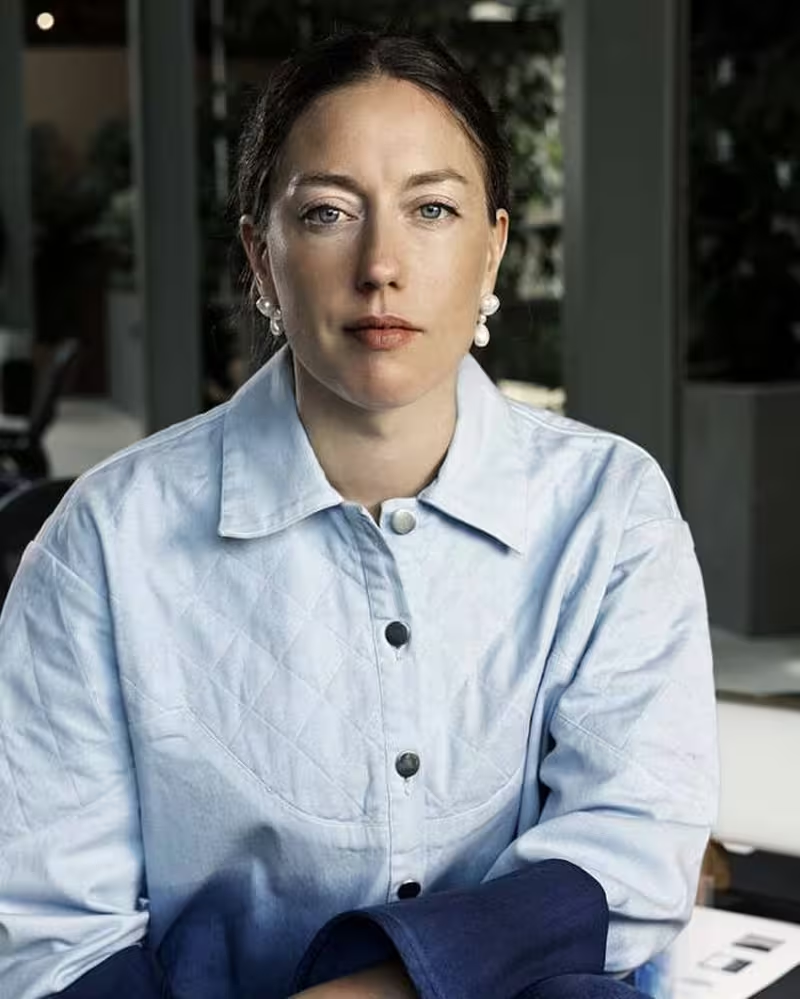
Marjan van Aubel is a Dutch solar designer known for work that asks a simple but radical question: why does solar energy have to be ugly? Through product innovations, immersive light installations, and architecture, her studio designs for a positive future. She is combining sustainability, design, and technology to make solar energy part of everyday life.
Her work is held in the permanent collections of MoMA in New York, the Centre Pompidou in Paris, the V&A in London, the Vitra Design Museum and the Stedelijk Museum Amsterdam. She co-founded the Solar Biennale and is the author of “Solar Futures: How to Design a Post-Fossil World with the Sun”.
Talk: Solar Futures
Solar design is more than a discipline. It is a new movement that revolves around designing with the sun. It shifts the narrative from solar being purely technical to a seamlessly integrated and beautiful part of our daily lives. It blends creativity, sustainability, and reverence for the sun and its abundant energy.
Solar design, a term started by Marjan van Aubel herself, envisions a world where solar integration is essential, not just a technical aspect added later. Instead, it should be the starting point – the foundation of the design process. It is believed that in the future, an object or building will be considered broken if it does not generate its own energy. How can we seamlessly integrate solar power into daily life while embracing aesthetics, interaction, and cultural values? How can we use this technology to create something beautiful that enriches our environment and the way we live together?
In her talk, Marjan van Aubel will give a historical overview of how we used to live and design with the sun, what we can learn from this and how to design a post-fossil future with the sun. Through examples of her work – Sunne, a self-powered solar light that mimics the sun, Ra, a solar tapestry, or the Solar Pavilion, a solar mesh on an architectural scale – van Aubel will inspire and provoke you to see solar energy in a new light.
Transcription
(Applause)
Thank you, Marc.
Well, I’m here in a pretty dark but cool room talking about the sun.
But yeah, there’s no light without darkness.
OK, let’s begin.
Because every hour we receive enough sunlight to provide the world with enough electricity for an entire year.
One hour is enough to power everyone everywhere(...) all the time.
Wow.
So why are we still looking down on the Earth for energy? Well, we should be looking up.
We are sun lighted, not just for one hour, but all the time.
Every day, the sun rises in the east and goes down in the west.
Every day, not only today, but also tomorrow, the day after that, the day after, and so on.
For already 4.5 billion years.
And we’ll continue to do so for another 5 billion years.
We are all here because of the sun.
Without the sun, there was no life.
Every bird, every tree, every mushroom, every animal, everything exists because of the sun.
The sun is everywhere. And because the sun is everywhere, we will capture it everywhere.
All right, think ahead. Think far, far ahead like sci-fi future.
Imagine a star with a whole sphere around it that will capture all its energy.
Or satellites that beam the energy of the sun onto the earth.
This is already something the European Space Agency is already working on.
But also here on earth, there will be buildings with solar, cars, textile, fashions.(...) And these examples I just show you, they’re not AI or something. It’s real. They’re being built. They do exist.
So in a couple of years, everything will be integrated with solar energy.
And now you’re thinking, yeah, OK, right. But do you remember that we went from something like this to everyone on their mobile phone all the time being connected?
I mean, I remember having-- not this one, but like this white 90s phone. And I had to be home. Everyone, my mom, could listen to the talks I had with my friends. And you had to be home to be connected, to be reachable. And something like this will happen with solar too. So now it’s specific to one place,(...) very big fields. But it will be integrated into everything.
The question is not when this is going to happen, because it is already happening. The real question is how.
And we can do this from necessity. And I think we all know what kind of more energy that we will have even more with the rise of AI.
Or we do it with true beauty.
And there’s nothing wrong with beauty. I mean, we all want to live in a beautiful house, have beautiful things, be surrounded by beautiful people.
And in the past, we’ve been designing beautifully with the sun.
For example, this is Stonehenge. And they really basically built this whole structure to sort of give a notion of time. So in the summer solstitch, when the sun was coming up, the sunrise, it would reach a certain place. And also, with winter solstitch.
And I mean, in the past, we didn’t ever watch your phone. We had to look up to see what time of day it was, and to see what time of year it was through the seasons.
Another example is this pyramid in ancient Mexico.(...) Very difficult name, Tia Torquan. I tried. OK, sorry.
But it’s really built to honor the sun gods.
And this is one of my favorite examples in Rome, the Pantheon, which has this big 8.3-diameter hole in the floor, in the ceiling, as its only light source.
So when you’re inside the Pantheon, you’re not bored, because you can see the light changing throughout the day, and see its sun path.
And what is really, really incredible is that they built this in such a way that on the 21st of April, which is the founding day of Rome, the emperor would come in and spend on this specific spot, and would be enlightened.
I mean, who builds a building just for that?
But I like this cathedral thinking. It’s like the architect, he never seen the building finished. It’s like it went way after his death, it was finished. And I like this cathedral thinking. And we shouldn’t think only about, OK, the next four years, but really, what kind of impact can we make? What’s happening in hundreds of years? What do we do now?
Another example is these windmills. I’m Dutch.
If you think about the Netherlands, you think of windmills.
And they’re not still here because they work very well. I mean, they were used to grind up chalk or flour or pump up water to another site.(...) And they did their job, but they’re still there because they’re beautiful. It’s an icon of the Netherlands. We’re very proud of it. It’s a monument.
I have a question for you.
These are one of the first solar panels ever installed in the world on a rooftop in New York.
When do you think this was?
Some more?
OK. 1884. Oh, wow. That’s pretty close, actually.
This is 142 years ago.
I mean, if I think about cars,(...) did it even exist then? I don’t think so. They were more like a bicycle or not really. There were no cars there. I mean, the first ones. But if you think about the clothing they have, or it’s like from a different time. I would say not so much has changed.
So I showed you there’s potential. The sun is always there. It has enormous potential. And then this is what’s happening to the technology and the design. So last week I was in Milan, the Salone del Mobile.(...) And I always get back a bit depressed because I’m like, do we really need another chair? Do we need another thing? It’s like this industry really needs design. And that’s why I focused at a certain moment. I stopped doing the other things and really focused my career on just being a solar designer.
Solar designer means I design with the sun.
And I’m not here to talk about the regular solar panels, the blue ones we all know from the roof, with its boring details, its efficiency, Bayback time.(...) I’m really here to talk about solar futures and why I started the movement.
And when I was studying at the Royal College of Art in London, there was no solar subject or something. You come there to follow your passion.
And my passion happened to be solar. I mean, it’s amazing that the sun hits the surface(...) and then electricity is being made, like just with photos hitting a surface and then these electrons move. And I mean, that’s incredible.
So it is kind of like this. And when I studied, when I graduated in 2012, which is quite a long time ago now, it was a different time because solar panels were still very expensive.(...) And in those 12 years--
is that 12 years?
I’m sometimes older than I think.
In that time, things have changed because solar is now the cheapest source of energy. And last year even,(...) more energy was taken from energy and wind than coal and gas, which is like, that’s massive. That’s massive.
And I find myself here in this kind of like a niche gap between this--
that’s kind of very satisfied because my biggest fear is to get bored. And I’m not bored at all because it touches on so many things. It touches on the technology, science, social.
It encompasses a lot of different things. I even written a book about this,
“Solar Futures”, the same title as the talk.(...) And this book has three parts. The first part was looking at the past. You need to know what happened, why are solar panels the way they are, how did we used to live with the sun?
It’s kind of like an encyclopedia that looks at different innovation, different examples.
The second part is the present, looking at what is solar design, who are the solar designers, solar architecture, solar fashion. And then the third part, the future,
what do we need to do really to design this post-fossil world with the sun?
So I’m a bit of a researcher, artist, and designer.
Let me show you some examples of my other work.
I worked with Swarowski, the crystal company.
And if you cut crystals in a certain way, you’re able to bend and direct the light onto a surface,(...) making them more efficient using aesthetics.
So you basically take the solar crystals in the light during the day, put them in docking station, and they will power these chandeliers.
So it’s again like efficiency and aesthetics.
And over the years, I came across of different technologies that’s not just like the blue panels.
And that’s where it really hit it off for me. I found, for example, solar cells that use the properties of colours to generate electricity, similar how photosynthesis work in plants,(...) where a plant converts light into sugar for the plants. These cells convert light into electricity.
And even cells that work indoors, I mean, imagine like surfaces that work indoors are colourful and things, and basically every object
can like power itself, can be a little power station.
So this is current table, where the whole tabletop consists out of these colour solar cells.
The table is orange because that’s a very stable colour for indoors.(...) And you see the pattern. I tried to see that the electrons are moving through and a bit of like a leaf structure because it becomes a bit of like a living object.(...) You can’t put too much stuff on it because otherwise it doesn’t work. You need to take care of it.(...) And then from the sides to the USB ports, you can charge your phone or iPad or something.
Well, the more surface you have, the more energy you can harvest.
So here in London, we replace all windows with these current windows, these sort of stained glass solar cells.
And actually, the nice thing was that people from the street came to power their phones through the window ledges.
And here, when I was ambassador at the Dutch design week, they asked for-- you have a place, you can do something there. And I was like, OK, wow. No budget, by the way.
Of course.
So I worked with an architect, V8 Architects, and we created this solar pavilion. And it had this shape that kind of follows the sun. It’s like a sort of blanket nearly that follows the sun. And you could climb up on the stairs, and you can basically look at the solar panels. Because these are not normal solar panels. They are printed with a special ink. And your eyes can see the colour, but the lights still go through. So you have amazing surfaces that harvest energy, like resonating surfaces.
We used the power that was collected during the day, in the evening for lighting and heat, two qualities of the sun.
Actually, this was the hottest design week of Everett. It’s always in October in the Netherlands.(...) We didn’t need the infrared sort of huggable panels that we had in the pavilion, but it’s like for next time. We can do that.
But this place was really like-- it became like a hub, like a fireplace. We had performances there, lectures, people drinking beer, dancing on the thing in the evening. So it was really like a place where people came together.
And this was for the World Expo in Dubai, the Dutch pavilion,(...) where the same architect, V8 architect,(...) they didn’t build a building. They basically designed a biotope, where food, energy, and water are combined.
So what you see is like this big tower.
And they took out in the desert from the air sort of particles, and they created them into rain. So you could actually drink water from the air.
There were mushrooms growing. There are plants growing. And they asked us to take care of the energy part.
I have a little film for that.
(Applause)
Oh.
(Applause)
Thank you.
(Applause)
What I really liked with this project is that a world exposed, it’s just there for six months. And then after that, basically all the pavilions become like a ghost city a bit, and they are left and don’t have a function. And what architects wanted was a completely circular, not building, but kind of building. So everything that we used was borrowed from local manufacturers. So you see the beams, they’re probably now being built for bridges, and the glass that we used for the solar panels was also borrowed from a local manufacturer.
A very interesting way of thinking of like,(...) yeah, how can you work with local research and think about circularity also in the solar cell itself?
Well, I spent way too much time on designing the patterns and the colours and stuff, and then it was just 20 meters high up. So it was hard to see. So I wanted to bring them a bit closer to you. So this is RAH. It’s a self-powering artwork.(...) You hang it in the window during the day’s charges,(...) and there’s a very thin lettering that’s like lighting up.
This one, for example, is acquired now by Santu Fompadou. And what I really like is that you can have different scales, different versions, it doesn’t matter what scale it is.
And it’s all in this very lightweight sort of foil, and everything is like the batteries and stuff are all combined in the artwork itself.
Here, this is a collaboration we did together with Lexus, the car company, and we basically put these sheets in a sort of 3D form. So it became a bit like a hologram of a car.
So when you would walk around the car, sometimes you didn’t see anything, and sometimes a car would appear.
It, of course, had integrated solar cells, but also sensors. So when you approach the car, the car noticed you, and you get a reaction in terms of lighting that changes constantly, and the music also reacted to you.
And this is one of my favourite things I did, I would say, because do you know the moment when you’re on the beach, or you see the sunrise, or sunset, and it goes under, and you think, "Oh, this is so beautiful, I want to keep this moment,"(...) and then it’s gone.
I want to create that moment into a light.
So this is Sunne. It’s a self-powering solar light.
One side has solar panels that you hang in front of the window, and the other side indoors mimics sunlight.
Yesterday someone told me, “Ah, basically you have 24-hour sun”. I kind of like that.
So the light has different settings. We can change from sunrise, sunset, or sunlight, and through an app you can basically see how much the light is charged, or see also how does it work.
So again, it becomes like this living object.(...) So some people said, “Oh, my light doesn’t work”, and then they showed a picture, “Yeah, it’s because it’s behind a big tree”.
Or some people told me that in the morning they had it in their living room, and in the evening they took it in their bedroom. So it’s really because it was functioning better there.
We started this as a Kickstarter a couple of years ago, and it went super well, a bit too well I would say, because the studio became like a lighting company, and I was not sure if that’s what I was wanting.
So now this year the lights will be taken over by a Dutch-American company.(...) They will distribute them worldwide. So I feel like a proper designer now.
Well, in order to change something, you need to really feel it, you need to be aware, and awareness happens when something like clicks,
and that happens through the senses,(...) through a nice sound or something you hear.
Beauty and magic also helped. I mean, we’re not going to change the energy system just with numbers.
And I showed you different works, for example, the self-powering table, the windows, the buildings,(...) that were all about converting the energy of the sun into electricity. But the sun has so many more qualities than just providing energy.(...) It gives us light, it gives us heat, it gives us a notion of time, fighting indeed, it makes us happy,(...) and we are all here because of the sun.
In this work, “The Sun My Heart”,
I wanted to bring you closer to the sun.
It’s constructed out of 77 Sunnes, and when you put your hand onto a pedestal, you kind of like, it reads things about you, and you get your own personal sunrise.
(Music)
And the sound you hear is the sound of the sun, captured by NASA, and we had this sound composer who turned this into this music that kind of works together with your tats and riffs, and riffs that kind of like, happens also when you meditate.
(Music)
So, I think it’s clear that my aim is to change the narrative of solar energy, and by doing that, you need to bring people together.
That’s why me and Pauline van Dongen started the solar movement.
And the solar movement is really there to bring everyone who works in the field of solar together, and that’s policy makers, architects, designers. Yeah, it’s not a discipline that just stick to one thing, but we need to collaborate there.
So, every two years, we held the solar biennial. The first one was in the Netherlands, in Rotterdam.(...) There was an exhibition in a new institute.
There were talks, there were things. There was like a program of 25 different programs. I can show you also a little clip that explains it nicely.
The solar biennial shows the importance of making a transition from solar technology to solar design, whereby our future is built upon the power of the sun. Every surface being an energy harvester, every object around us, and reconnecting us with our natural environment.
The solar biennial is a short period of time, of seven weeks, where we aim to bring a lot of different perspectives together.
It grounds you in the place where you are at that moment in time. It also connects you with your personal energy,(...) the kind of like direction you want to go in, in terms of inspiration.
My connection to the sun, I see it as something that brings life.
When the sun is out, I always feel like performing with my hula hoops, and I really like the dynamics and the highlights that it gives to our day.
I feel alive when the sun shines. As an artist, I think that the sun is the most inspiring thing for everything that exists, you know, and it brings out the best in everyone.
I feel that we all are radiant beings. We all have radiant energy within us that shines bright. And, you know, when it’s time to relax on one end, it’s still constant on another end. It’s a never-ending thing. It’s infinite, just like the ideas that we may have, or the love that we may have within this lifetime.
What I also find interesting is that the rising and setting of the sun is a point of reference for everyone.(...) But at the same time, I find it a bit scary because it is a way of watching the time pass.
Solar energy needs some new perspectives, and that’s what we want to show and bring a lot of people together.
Mostly, I’m the weird one out in a conference like this. There are no other solar designers, but this was the first time I wasn’t the weird one out.
And the second one, actually, we held one last year as well in Switzerland, in Mudac. And the title of that one was “Soleil-s”, because they think the future of solar is pure. There are several futures.
It had a major exhibition of different solar designs. It shows how we live with the sun.
Installations, for example, about heliotropism. If people follow the sun and what kind of culture it creates, related to the solar punk movement, which is a very utopian way of looking at the world where solar energy has a big part.(...) There were super nice installations together with EPFL.
These ones you maybe know now.(...) And this was the first time that the curator said, “I found a place near the window, because mostly in the museum, work can never be shown in a real window, so I was happy with this”.
But for me, this was super touching that people from the first biennial came to the second. And I felt really that we started a movement where we were growing.(...) And the idea is that every two years, we move to a different location in the world. Fingers crossed it will be Japan next time, working on it.(...) What I like is that the sun behaves different in all different parts of the world. The Netherlands also had different questions than, for example, Switzerland. And if we would have a biennial in, say, Africa, there’s too much sun, so how do you handle that? Do we have to work about shading, for example?
And the Netherlands and Switzerland, too, is a lot about efficiency. There’s not a lot of space, so you have to think about how do we make the best of it, and can we make this more beautiful, because there’s not so much space.
So the next step is also to create a solar academy, because that’s a question I get asked a lot. How do I become a solar designer?
And before setting up the first biennial, and also during this, we created this manifesto with eight principles.(...) And it’s kind of like a guideline, because if we start thinking that producing the energy is like an essence of a design, I mean, I think in the future we will consider a building that is broken if it doesn’t generate its own energy. We have to start designing it differently, and we have to not add solar panels last, which is happening now, but really that’s the core of design.
You have to work together a lot, because we’re designers, we’re not tech experts. I mean, I wish I was a bit more like Nils, that’s going mad with all these crazy things, you know, he just does it. It’s very impressive.
But we have to collaborate with a lot of people, and also it’s neither constant, you don’t know when the sun is shining, so how do you work with, for example, non-constant factors?
So this is something I’m very excited about, like to really like, the aim is to have like a solar master, where people learn how to become a solar designer.
Well,(...) I think solar design is inevitable,
and in a couple of years everything will be surrounded, will be integrated with solar energy,(...) and not just the obvious things, such as the buildings, but also the small and not obvious things.(...) There will be music, dance, AI,(...) the tellerrand Conference, all powered by solar.
And despite all our flaws, horrible power structures,
there’s always the sun,
for another five billion years.
Thank you for listening, thank you.
(Applause)